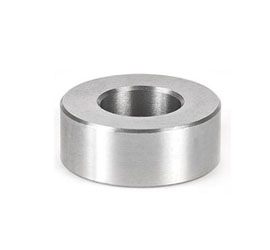
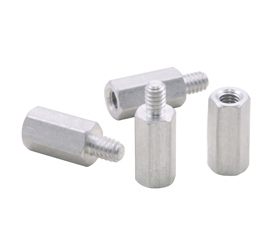
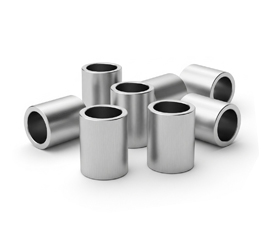
We are an OEM custom aluminum spacer and aluminum standoff spacer manufacturer. We manufacture CNC-machined aluminum spacers according to customer drawings, samples, and specifications. We support different types of spacers such as round, hollow, hex, threaded, unthreaded, sleeve, stud, and standoffs.
Aluminum material grades, surface finishes, dimensions, tolerances, and threads can be manufactured according to customer requirements. We support both metric (mm) and imperial (inch) sizes. We can provide samples before mass production and support medium to high-volume production.
Send Your Drawing for a Custom Aluminum Spacer QuoteAluminum spacers are typically unthreaded and are used to maintain a fixed distance between components. A screw or bolt passes through the spacer to provide alignment and clearance during assembly. Aluminum spacers are commonly used in electronics, automotive components, machinery, aerospace equipment, and industrial assemblies.
An aluminum standoff is a threaded spacer with internal threads, external threads, or both. It is used to separate and securely fasten components while providing a threaded mounting point. Aluminum standoffs are commonly used for mounting printed circuit boards (PCBs), electronic enclosures, control panels, telecommunications equipment, and industrial assemblies.
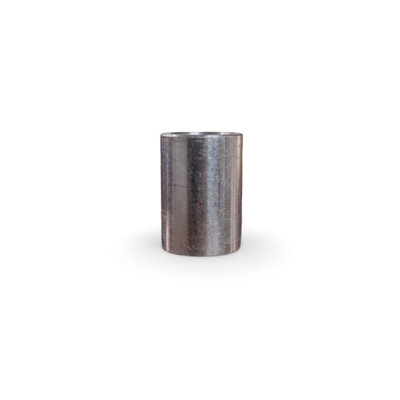
Material : Aluminium Alloy T66
Spacer Type : Unthreaded spacer Sleeve
Inner Diameter (ID) : Ø0.39"
Outer Diameter (OD) : Ø0.55"
Overall Length : 0.79"
Chamfer : 0.02" × 45° on both ends
Custom unthreaded aluminium sleeve spacer made from Aluminium Alloy T66 with a Ø0.55 inch outside diameter, Ø0.39 inch inside diameter, and 0.79 inch overall length. The aluminium spacer has a 0.02 × 45° chamfer on both ends.
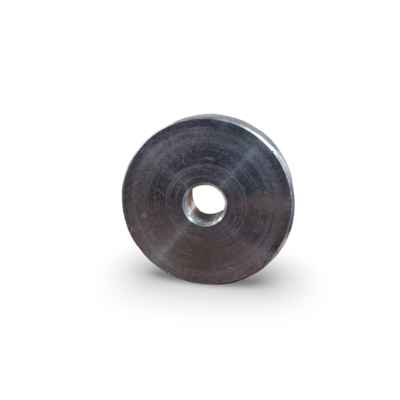
Material : Aluminium 6061
Spacer Type : Round spacer
Inner Diameter (ID) : 0.25"
Outer Diameter (OD) : 1.25"
Thickness : 0.1875"
Custom round aluminium spacer manufactured from Aluminium 6061 with a 1.25 inch outside diameter, 0.25 inch inside diameter, and 0.1875 inch thickness. This aluminium spacer provides a compact cylindrical form for controlled spacing, alignment, and clearance between components in mechanical assemblies.
Aluminum spacers and standoffs are available in different shapes and thread configurations.
| Type | Description | Common Applications |
|---|---|---|
| Aluminum Round Spacer | Cylindrical unthreaded spacer used to maintain a fixed distance between components. | Electronics, machinery, panel assemblies |
| Aluminum Hex Spacer | Spacer with a hex body for easier wrench installation and tightening. | Control panels, industrial equipment |
| Aluminum Hollow (Sleeve) Spacer | Tubular spacer with a clearance hole that allows a screw or bolt to pass through while maintaining spacing between components. | PCB mounting, brackets, enclosures |
| Aluminum Unthreaded Spacer | Plain spacer designed to provide clearance and maintain a fixed distance between components. | General mechanical assemblies |
| Aluminum Female-Female Standoff | Internal threads on both ends for mounting components with screws. | PCB mounting, electronic enclosures |
| Aluminum Male-Female Standoff | Threaded aluminum spacers have an external thread on one end and an internal thread on the other for mounting and spacing components. | Panel mounting, electronic equipment |
| Aluminum Male-Male Standoff | External threads on both ends for mounting and spacing components. | Mechanical and electronic assemblies |
| Item | Details |
|---|---|
| Material | 6061-T6, 7075-T6, 6082-T6, 6063, or customer-specified aluminum grades |
| Manufacturing Process | CNC turning as the primary process. Drilling, tapping, threading, milling, chamfering, and deburring performed according to part requirements. |
| Dimensions | Custom OD, ID, length, wall thickness, and overall dimensions according to customer drawings |
| Finish | Natural, clear anodize, black anodize, hard anodize, bead blast, powder coat, or customer-specified finish |
| Thread Type | Metric (ISO), UNC, UNF, or customer-specified threads |
| Thread Size | Metric: M2, M2.5, M3, M4, M5, M6, M8, etc. Imperial: #2-56, #4-40, #6-32, #8-32, #10-24, 1/4-20, and other UNC/UNF sizes |
| Tolerance | ±0.1 mm typical; tighter tolerances available according to drawing requirements |
| Inspection | Dimensional inspection according to customer drawings and specifications |
| Material Certification | Available on request |
| Packaging | Bag, carton, pallet, or custom packaging |
| Typical Lead Time | Approximately 3-4 weeks depending on quantity, complexity, and surface finish |
| Minimum Order Quantity (MOQ) | According to product drawings and specifications |
Most common aluminum grade for CNC-machined spacers and standoffs. 6061-T6 provides excellent machinability, good strength, corrosion resistance, and is well suited for anodizing. This grade is commonly used in electronics, automotive, machinery, and robotics.
Much higher strength than 6061 while maintaining a similar weight. Commonly used for spacers where high mechanical loads and weight reduction are important. It has lower corrosion resistance than 6061. Mostly used in aerospace, drones, racing, and high-performance applications.
Widely used for structural machined components, especially in Europe. It provides higher strength than 6061 with good corrosion resistance and machinability.
Primarily an extrusion alloy with an excellent surface finish and good anodizing characteristics. Less common for precision CNC spacers because it has lower strength than 6061. Commonly used for architectural components, extruded profiles, and light-duty spacer applications.
Clear anodizing maintains the natural aluminum appearance and adds a thin, hard protective layer. It improves wear and corrosion resistance. It is a good choice when you need a clean, natural finish. It is commonly used in control panels and indoor enclosures.
Makes the part black while improving corrosion and wear resistance. It is commonly used when a black appearance is required for visible components.
This creates a thicker, harder surface with excellent wear and abrasion resistance. It is a good choice for parts exposed to frequent use or harsh operating conditions.
Bead blasting gives a soft, textured surface. It hides small tool marks and creates a smooth, even matte finish. It is commonly used before anodizing or when a uniform appearance is required.
This adds color and a thick protective coating. It provides additional corrosion resistance and is commonly used when appearance and surface protection are important.
Aluminum hex spacers, hollow spacers, and standoffs are commonly used for mounting printed circuit boards (PCBs). They maintain proper spacing between components and provide secure mounting inside electronic assemblies.
Round spacers maintain the required distance between panels and internal components. They help maintain alignment during assembly and installation.
Spacers maintain accurate spacing between plates, brackets, and machine components. They help with alignment during assembly, machining, and welding.
Aluminum spacers are widely used because of their high strength-to-weight ratio, good corrosion resistance, and machinability. Common applications include brackets, sensor mounting, battery assemblies, aerospace equipment, and lightweight mechanical assemblies.
Both are similar, but a spacer sleeve is typically a hollow cylindrical spacer with a clearance hole for a screw, bolt, pin, or shaft. Unthreaded spacers may be solid or hollow, depending on the application.
Yes, aluminum has natural oxide protection, and anodizing improves corrosion resistance.
Yes, aluminum spacers handle more load and heat compared to plastic or nylon alternatives.
Choose an aluminum spacer when only a fixed distance is required between components. Choose an aluminum standoff when the assembly also requires internal or external threads for fastening.
No. Aluminum is electrically conductive. If electrical insulation is required, nylon or other non-conductive spacer materials should be considered.
Yes, but the operating environment should be considered. In wet or corrosive environments, direct contact between aluminum and stainless steel may increase the risk of galvanic corrosion, so suitable coatings or insulating washers may be recommended.
To request a quotation for aluminum spacer and aluminum standoffs, please send your drawing or sample.
Please include the following information:
After receiving the RFQ, we review all details. If clarification is required, we contact the customer before quotation. Quotation, estimated lead time, and shipping details are shared based on the confirmed scope.