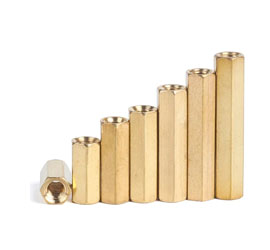
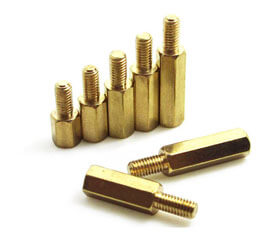
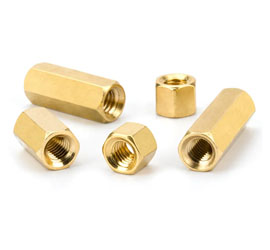
We are a manufacturer and supplier of custom brass spacers and brass standoffs according to customer product drawings and samples. We support custom thread sizes, holes, dimensions, and designs as per buyer requirements. We support both metric and inch thread standards.
For brass spacers, we use CNC turning, milling, threading, boring, and step machining according to the spacer design. We support different custom brass material grades according to requirements. We support both metric and inch dimensions.
We manufacture brass spacers & standoffs in custom configurations such as round brass spacers, brass threaded spacers, hex brass spacers and standoffs, brass flat spacer, brass unthreaded spacers, brass shoulder spacer, brass swage spacers, etc. Our brass standoff spacer are used in PCB mounting, board spacing, electronics, sensor assemblies, panel assemblies, and multi-board assemblies.
We support prototypes, as well as medium to high-volume repeat orders. We supply brass spacers to customers in the USA and across European markets, including Germany, France, Croatia, Spain, the Czech Republic, the Netherlands, Italy, and the UK.
Request a Quote Today for Custom Brass Spacers And Standoffs| Item | Brass Spacer Specification |
|---|---|
| Material | Brass IS319, C36000, Custom brass grade according to drawing |
| Manufacturing Process | CNC turning, CNC milling, drilling, boring, tapping, threading, step machining, chamfering, and deburring according to part requirements |
| Spacer Types | Round / Tubular Brass Spacers, Threaded Brass Spacers, Hex Brass Spacers and Standoffs, Flat Brass Spacers, Shoulder Brass Spacers, Swage Brass Spacers, and custom designs |
| Thread Standard | Metric and inch thread standards |
| Metric Thread Sizes | M2, M2.5, M3, M4, and other customer-specified metric sizes |
| Inch Thread Sizes | #2-56, #4-40, #6-32, #8-32, #10-32, 1/4-20, and other customer-specified inch thread sizes |
| Thread Configuration | Female-Female, Male-Female, Male-Male, and customer-specified configurations |
| Thread Type | Internal threads, external threads, and through-threads according to spacer design |
| Surface Finish | Surface finish according to customer drawing and specifications |
| Tolerance | General tolerance ±0.10 mm; tighter tolerances according to customer drawing and critical dimension requirements |
| Inspection | Dimensional inspection of critical dimensions according to customer drawings and specifications |
| Material Certification | Available on request |
| Packaging | Customer-specified packaging requirements |
| Typical Lead Time | Approximately 3-4 weeks depending on quantity, part complexity, material, and surface finish |
| Minimum Order Quantity (MOQ) | Depends on part complexity, material grade, manufacturing process, and production requirements |
| Drawings Accepted | STEP, PDF, DXF, and DWG files |
| Tooling | Custom tooling according to production requirements |
Brass round spacers have a round shape cylindrical body with a through bore. They maintain a fixed distance between components while allowing a fastener to pass through the bore. Round brass spacers are mostly used in electrical equipment, PCB mounting, and sensor assemblies.
brass hex spacers have a six-sided body that provides wrench flats for installation. We make brass hex standoffs with male-female and female-female threaded configurations. They are commonly used in electronic and mechanical assemblies for mounting and spacing.
Brass threaded spacers combine a fixed spacing length with threaded fastening points. Depending on the design, the threaded spacer can have internal threads, external threads, or both.
Brass swage spacers and standoffs are designed for installation into panels by swaging. We make them in round and hex configurations, with threaded and clear-hole versions. They are used for panel and electronic assemblies.
Brass hinged standoffs use a hinged mounting design that allows movement during assembly while maintaining the required board spacing. They are used in selected PCB and panel mounting applications.
We manufacture brass spacers according to the material grade specified in the customer drawing. We can work with US, European, Indian, and customer-specified brass material standards. If the customer does not mention a material grade in the drawing, then IS 319 Gr 1 free-cutting brass is our default standard grade for manufacturing brass spacers.
C36000 is a widely used free-cutting brass for machined components. It is specified under ASTM B16/B16M for free-cutting brass rod, bar, and shapes used in screw machines. Its high machinability makes it suitable for CNC-machined brass spacers and other brass CNC turned parts.
European brass designations such as CW614N (CuZn39Pb3) and CW617N (CuZn40Pb2) are used for brass products supplied to European specifications.
IS 319 covers free-cutting brass bars, rods, and sections.
We manufacture brass spacers according to the material grade specified in the customer drawing. The required grade, material condition, and applicable material standard are followed according to the order requirements.
Brass spacers are conductive, nonmagnetic, and corrosion-resistant in damp environments. They are suitable for electrical equipment, circuit boards, and sensors.
Brass provides high machinability. Grade C36000 free-cutting brass high machinability. In brass spacer have CNC turning, internal threads, and external threads. bores, shoulders, step profiles, hex profile, and precision dimensions. For all these machine operations, brass is better suited.
Brass is not as electrically conductive as pure copper. Brass spacers provide electrical conductivity along with mechanical support and spacing. These properties make them suitable for electrical equipment and electronic assemblies where brass spacers must remain conductive.
Brass alloys are generally nonmagnetic, which makes brass spacers suitable for electronic assemblies.
Brass spacers are useful when exposed to normal atmospheric moisture and when corrosion resistance is needed without coating in damp environments. They are also useful where a conductive metal spacer with corrosion resistance is required.
Copper spacers have higher electrical conductivity. Aluminum spacers have lower density and weight. Steel spacers generally have higher strength. Brass spacers provide a useful combination of mechanical strength, electrical conductivity, machinability, and corrosion resistance. Brass is selected when a spacer needs a balance of these properties rather than maximum performance in only one area.
Brass spacers are used in electrical and electronic assemblies. Brass spacer uses include circuit-board mounting, sensor assemblies, panel hardware, and board-stack applications. Brass is also selected for these applications because it is electrically conductive, nonmagnetic, and good machinability.
Brass spacers are used to maintain a defined distance between a PCB and its mounting surface, chassis, and circuit board. Threaded brass standoffs can secure the board while maintaining the required board height. We make round and hex body shapes with different male-female and female-female thread configurations.
Brass spacers are used inside electronic equipment to support mounted boards and hardware. Brass's electrical conductivity and nonmagnetic properties make it suitable for selected electronic mounting applications.
Brass spacers are used in sensor assemblies to maintain the required spacing between the sensor and its mounting components. The spacer brass can also provide a conductive mounting path where the design requires electrical continuity.
Brass spacers and standoffs are used in panel assemblies. Swage-mounted brass spacers can be secured to suitable panels, while threaded brass standoffs provide a mounting point for attached components.
Brass standoffs are used to maintain spacing between stacked circuit boards and to secure PC/104 and PC/104-Plus modules. Brass standoffs are used for limited-space board stacks and computer power-supply assemblies.
Brass hinged standoffs are used with terminal boards to maintain component spacing while providing access to mounted components during testing and troubleshooting. Brass hinged standoffs are used with printed circuit boards and terminal boards.
Yes. Plating can affect the electrical contact performance of a brass spacer because the plating becomes part of the contacting surface. When the spacer must carry electrical current, the plating and contact requirements should be specified with the application.
Yes. Brass spacers can be used in many damp environments without plating because brass has good resistance to atmospheric corrosion. More aggressive environments involving salt water, chemicals, and continuous moisture may require a suitable alloy and protective finish.
Yes. Brass is softer than steel, so excessive tightening can deform brass threads. The required tightening torque should be based on the brass grade, thread size, thread engagement, fastener, and assembly design.
Brass spacers can be used in assemblies that require repeated installation, but repeated tightening can wear brass threads and surface plating. The spacer design, brass grade, thread engagement, tightening load, and required number of assembly cycles should be considered.
Yes. Brass spacers can have different thread configurations at each end, such as male-female, female-female, and male-male configurations.
Yes. Brass spacers can be manufactured with a through-thread. Female-female brass spacer products are available with an internal thread extending through the body.
Yes. Brass spacers can be assembled with steel fasteners. The tightening load should suit the softer brass component, and wet environments should be evaluated for galvanic corrosion between the dissimilar metals.
The terms can overlap in commercial products. A brass spacer is generally used to maintain a defined distance between components. A brass standoff commonly includes a threaded feature that also provides a mounting point for fastening components.
To request a brass spacer quotation, send your STEP (3D) file along with a PDF drawing and RFQ details.
Please include:
Send your RFQ and drawings to receive a quotation with pricing and indicative lead time.
Request a Quote Today for Custom Brass Spacers