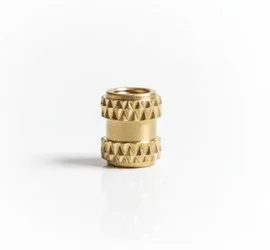
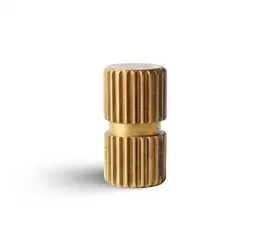
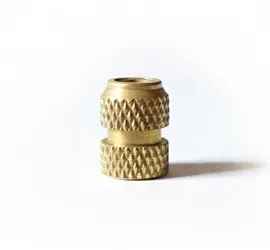
A brass molding insert is an internally threaded brass component used in plastic injection molding. The manufacturer places it inside the mold before plastic injection. A core pin locates the insert, and molten plastic flows around its external geometry. After cooling, the finished plastic part holds the insert and leaves its internal thread available for a mating screw.
We manufacture custom brass molding inserts in different sizes, thread configurations, knurl patterns, lengths, and custom designs according to customer drawings. Our brass moulding inserts are used in electronics, automotive, and molded plastic components. We manufacture different brass insert configurations such as headed, unheaded, flanged, blind, through-hole, and expansion inserts. We support both inch and metric thread configurations.
We support medium- to high-volume production requirements. Samples and a small batch are also supported for quality and testing.
We supply brass molding inserts to OEMs, distributors, and industrial buyers in the United States, Asia, and across European markets, including Germany, France, Spain, the Czech Republic, the Netherlands, the UK, and Italy.
Request a Quote for Custom Brass Molding InsertsA some plastic thread does not provide repetitive thread tightening and removal. This problem solve brass molding insert, it gives the plastic part an internal metal thread for fastening.
Brass molding insert external geometry transfers fastening loads into the surrounding plastic, and the outer design controls how plastic engages with the insert.
Material: Brass
Insert Type: Terminal Insert (Short), Brazed
Knurling: Outside surfaces knurled for plastic flow
Knurled Outside Diameter: Ø0.260 ± 0.010 inch, after knurling
Internal Thread: 6-32
Internal Feature Diameter: Ø0.200 inch
Tip Dimension: 0.050 inch
Section Dimension: 0.120 inch
Brazed Contact Length: 0.080 inch
Brazed Contact Diameter: Ø0.125 inch
Brazed Contact Thickness: 0.020 ± 0.001 inch
Chamfer: Ø0.17 inch max
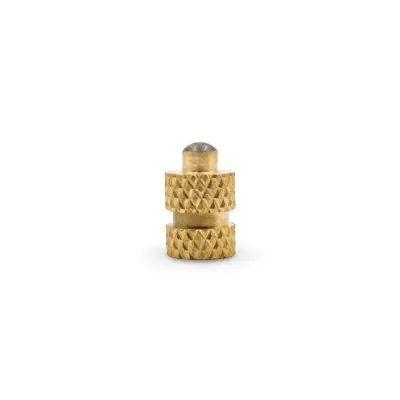
We manufacture this custom brass terminal molding inserts in the short brazed configuration, using free cutting 319 grade 1 brass with external knurls for plastic flow and a 6-32 internal thread. The brass molding insert has a Ø0.260 ± 0.010 inch outside diameter after knurling, Ø0.200 inch internal feature, Ø0.125 inch brazed contact, and 0.020 ± 0.001 inch contact thickness.
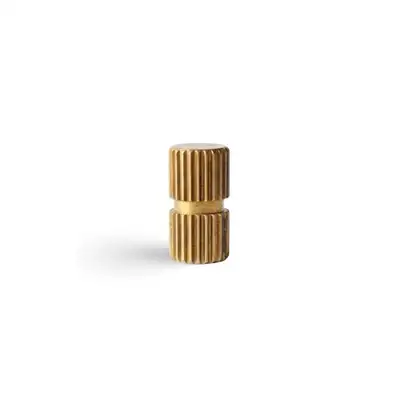
Material: IS 319 Grade 1 Free Cutting
Insert Type: Blind hole insert with straight knurling
Thread: ISO Metric M6
Overall Length: 17 mm
Knurling Length: 7.50 mm
Outside Diameter (OD): 9 mm
Groove Width: 1.95 mm
Groove Diameter: 7.50 mm
We manufacture custom brass blind hole inserts with straight knurled outer surfaces and an ISO Metric M6 thread. This 17 mm long brass moulding insert uses a closed top end for blind-hole installation in plastic materials, with a 9 mm outside diameter, 7.50 mm knurling length, 1.95 mm horizontal slot, and 7.50 mm slot OD. The straight knurling supports secure installation and thread retention, and the horizontal slot helps control installation and alignment.
The outer profile gives the plastic features that retain the insert. Brass molding inserts can use knurls, grooves, undercuts, and shaped bodies for retention.
Mold-in brass knurling insert can have diamond, opposing diagonal, and opposing herringbone knurling patterns for retention.
Grooves and undercuts give the plastic parts additional areas for fill during plastic molding, and they can increase pull-out resistance.
Hexagonal-shaped outer bodies can give the plastic a shaped surface around the insert.
Brass mold-in inserts with symmetrical designs can simplify feeding and positioning during production.
Brass moulding inserts come in different designs, and the main differences are thread, head shape, body, and external knurl, groove, and undercut features.
A through-hole brass insert has a threaded passage that extends through the insert body.
A blind-end brass insert has a closed end below the internal thread, and this design helps prevent plastic from entering the internal thread during molding.
A headed brass insert has an added shoulder at one end. This gives the insert a larger end geometry.
Hexagonal body designs can provide anti-rotation geometry.
Knurls, grooves, and undercuts give the surrounding plastic additional geometry for mechanical retention.
Brass molding inserts use metric threads and Unified inch threads. Metric threads use pitch, and Unified inch threads use threads per inch (TPI).
ISO metric threads use the M designation. For example, M3 × 0.5 means an M3 thread with a 0.5 mm pitch.
| Thread system | Thread size | Pitch | Thread type |
|---|---|---|---|
| ISO Metric | M2 × 0.4 | 0.40 mm | Metric |
| ISO Metric | M2.5 × 0.45 | 0.45 mm | Metric |
| ISO Metric | M3 × 0.5 | 0.50 mm | Metric |
| ISO Metric | M3.5 × 0.6 | 0.60 mm | Metric |
| ISO Metric | M4 × 0.7 | 0.70 mm | Metric |
| ISO Metric | M5 × 0.8 | 0.80 mm | Metric |
| ISO Metric | M6 × 1.0 | 1.00 mm | Metric |
| ISO Metric | M8 × 1.25 | 1.25 mm | Metric |
| ISO Metric | M10 × 1.5 | 1.50 mm | Metric |
| ISO Metric | M12 × 1.75 | 1.75 mm | Metric |
Note: The sizes shown in these tables are for reference only. Actual thread sizes and availability may vary by manufacturer and insert series.
Inch-threaded molding inserts use Unified thread designations. For example, 4-40 has 40 TPI and 10-32 has 32 TPI.
| Thread size | TPI | Thread series |
|---|---|---|
| #2-56 | 56 | UNC |
| #4-40 | 40 | UNC |
| #5-40 | 40 | UNC |
| #6-32 | 32 | UNC |
| #8-32 | 32 | UNC |
| #10-24 | 24 | UNC |
| #10-32 | 32 | UNF |
| 1/4-20 | 20 | UNC |
| 1/4-28 | 28 | UNF |
| 5/16-18 | 18 | UNC |
| 3/8-16 | 16 | UNC |
| 1/2-13 | 13 | UNC |
Note: The sizes shown in these tables are for reference only. Actual thread sizes and availability may vary by manufacturer and insert series.
Brass mold-in inserts are used in various applications, including automotive, electronics, home appliances, and consumer products.
Automotive plastic components can use brass threaded inserts. Vehicle interiors, exterior plastic-trim components, and under-bonnet sub-assemblies are documented automotive application areas.
Electronics applications include OEM products and contract-molded assemblies.
Rail components can use in-mould brass threaded inserts in composite panels and infusion-moulded parts.
Only when the insert design supports molding-in. Brass threaded inserts made for heat insertion, ultrasonic insertion, press-in installation, and self-tapping use belong to different installation methods.
A mold-in insert goes into the plastic part during molding. Post-mold installation uses a different insert and installation process.
Molded-in inserts can become part of the rework process when a molded plastic part has a defect. Removal may be required before the plastic part can be reground. Repair suitability depends on the specific component.
Yes. Operators can place molded-in inserts before mold closure, and automated pick-and-place equipment can also load inserts.
Some brass mold-in insert designs support thin-wall plastic components. The insert design and molded part need to meet the required design conditions.
A suitable brass insert can provide a metal contact surface within a molded plastic assembly. The specific insert design needs to support the required electrical function.
Plastic can enter the internal threads during molding. This can affect the finished threaded area and may require thread checking after molding.
To request a brass molding insert quotation, send your drawing and RFQ details.
Please include:
Send your RFQ and drawings to receive a quotation with pricing and indicative lead time.
Request a Quote for Custom Brass Mold-in Inserts