A brass coupling is a brass fitting that joins two compatible ends in a fluid-carrying system, and it connects pipe, tubing, and hose ends. Equal couplings join the same-size pipe; reducing couplings connect different sizes; repair couplings help to join damaged pipe.
Brass couplings (brass coupler) are commonly used in plumbing and water-supply lines, HVAC Fittings, irrigation, pneumatic lines, and fluid-transfer systems. Common connection styles include threaded, compression, push-to-connect, PEX crimp/expansion, and hose barb designs.
We are a custom brass coupling manufacturer according to customer drawings and samples. Our common coupling ranges include brass socket coupling, brass compression coupling, brass reducing coupling, brass hose coupling, and brass quick coupling. Common sizes of brass couplings are 1/2", 3/8", 1", 3/4", 5/8", and 1-1/2 ". Brass coupler are manufactured through forging and CNC machining according to part requirements. Additional machining operations such as drilling, tapping, threading, chamfering, and deburring are performed as required. We support both metric (mm) and imperial (inch) sizes.
We manufacture brass couplings using brass material grades according to customer drawings and samples. We support custom brass grades such as C36000 US standard, CW614N European grade, as well as our standard grade IS 319 grade 1, and also support lead-free brass grade according to requirements.
We supply OEM brass couplings to manufacturers, distributors, and industrial buyers in the USA, Asia, and European markets, including Germany, France, Spain, the Czech Republic, the Netherlands, the UK, and Italy.
We support medium- to high-volume production requirements. For quality and testing, we also support samples and small batches.
Request a Quote For Custom Brass Pipe CouplingWe manufacture different designs of brass connectors and couplings, such as brass socket couplings, compression couplings, reducing couplings, hose-barb couplings, and quick-connect couplings, according to customer drawings. Here are our common types.
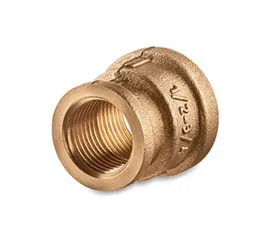
Socket brass couplings join two compatible pipe ends. Some brass socket couplings have internal threads at both ends, and they connect to pipes with matching external threads.
Brass compression fitting couplings join tube ends using compression nuts and rings that grip and seal the tubing.
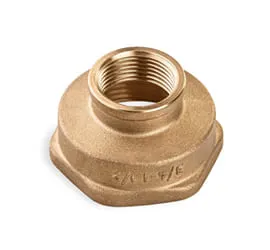
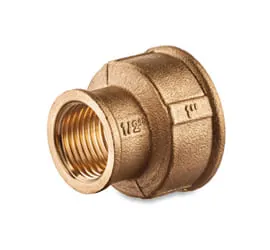
Brass reducing couplings connect pipes, tubes, or other compatible line components with different connection sizes. Equal couplings join ends of the same size, and reducing designs let a system connect differently.
Brass hose-barb nipple couplings connect flexible hoses through barbed ends, and a hose clamp may provide additional retention.
Brass quick couplings provide a connection designed for fast assembly. Push-to-connect designs accept compatible tubing into the fitting body. Quick-disconnect designs use a matching plug and socket to allow repeated connection and disconnection.
| Item | Specification |
|---|---|
| Material | Brass, including C36000, CW614N / CuZn39Pb3, IS 319, and customer-specified brass grades |
| Manufacturing Process | CNC turning, drilling and boring, thread machining, secondary machining, and machining of forged blanks for forged designs |
| Flare Fittings Designs | Brass quick coupling, brass compression Coupling, brass hose coupling, brass reducing coupler, brass socket coupling, and custom designs as per drawing |
| Thread Standards | BSP, BSPT, NPT, Metric, and customer-specified thread types |
| Thread Sizes | According to part drawing |
| Surface Finish | Natural brass, tin plating, tumbled finish, and customer-specified finishes |
| Tolerance | General machining tolerance: ±0.1 mm Tighter tolerances reviewed case by case |
| Inspection | Dimensional and thread inspection according to drawing requirements, using calipers, thread gauges, and other suitable measuring equipment |
| Material Certification | Available on request, according to order requirements |
| Drawing Formats | STEP, PDF, DXF, DWG, and customer-specified formats |
| Packaging | Poly bags, boxes, master cartons, pallets, and custom packaging |
| MOQ | Based on part geometry, material, tooling, quantity, and production requirements |
| Production Volume | Prototype / sample before batch (1–10 pcs) Medium and repeat OEM production preferred Standalone very small orders not supported |
| Lead Time | According to the quantity |
Brass couplings are used to connect compatible pipe, tubing, and hose sections in plumbing, pneumatic equipment, and industrial fluid systems.
Threaded socket couplings are used to join threaded pipe sections in plumbing and water-supply lines.
Brass quick couplings connect compressed-air lines to air compressors, pneumatic tools, assembly lines, and machinery. Brass compression couplings also join tubing in pneumatic equipment.
Brass compression couplings connect tubing in cooling lines, lubrication lines, water lines and industrial fluid-transfer systems. Some couplings are also used in machining oil, fuel and hydraulic oil.
Depending on the specific fitting and hose, brass hose-barb couplings can connect flexible hoses in low-pressure air, water, oil, fuel and lubrication lines.
Reducing couplings connect line ends with different sizes. Use them at size transitions in plumbing, water-supply lines, and equipment piping. Match both end sizes and the connection style to the existing system.
A brass coupling has a compact body, but its shape depends on the connection design. A threaded socket coupling usually has a short body with internal threads at both ends. A compression coupling has a body with compression nuts. A reducing coupling has ends with different sizes. A hose-barb coupling has rigid ends that fit inside a flexible hose. A quick-disconnect coupling has two matching parts, a plug and a socket, that connect together.
In plumbing, “coupling” and “coupler” often refer to the same fitting used to join compatible line sections. In some hose and quick-disconnect systems, “coupler” refers to the female half that connects to a matching male plug.
No. BSP and NPT threads have different thread profiles and angles, with pitch differences in many sizes. Threads may appear to engage without forming a reliable seal.
For threaded pipe connections, match the nominal pipe size and exact thread designation. For compression couplings, match the tube's outside diameter and material. For hose-barb couplings, match the barb diameter to the hose's inside diameter. Check the size at both ends of a reducing coupling.
Only when the fitting manufacturer specifies both tube materials. A fitting designed for rigid copper tubing may rely on the tube wall for support. Plastic tubing may need a compatible internal support insert. Check the approved tube material, dimensions, and installation instructions before assembly.
No. Confirm that the specific coupling meets the approval requirements in the destination market. In the United States, NSF/ANSI/CAN 372 addresses lead content, while NSF/ANSI/CAN 61 addresses health effects from contact with drinking water.
The correct method depends on the thread standard and sealing design. NPT and BSPT tapered connections commonly use a suitable thread sealant. BSPP parallel connections need a separate sealing surface because the threads themselves do not create a pressure-tight seal. Follow the fitting manufacturer's installation instructions and check sealant compatibility with the fluid.
To request a brass pipe coupling quotation, send your drawing and RFQ details.
Please include:
Send your RFQ and drawings to receive a quotation with pricing and indicative lead time.
Request a Quote For Custom Brass Couplings