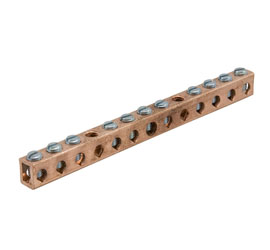
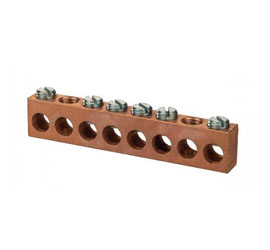
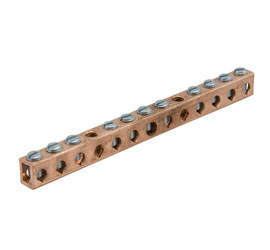
We are an OEM copper neutral bar manufacturer and supplier. Copper neutral bars are also known as copper neutral links. We make custom copper neutral bars according to customer requirements, drawings, and samples. We support custom copper grades according to customer requirements.
We use CNC-controlled SPM machines designed for operations such as drilling, tapping, chamfering, and slotting on neutral bars. Copper neutral bars are used in electrical panels, switchgear, power distribution boards, and control panels. Our customers include OEM panel manufacturers and distributors across the USA, UK, Europe, and Asia. We support medium to bulk volumes and samples according to customer requirements.
Request Quote Today For Custom Copper Neutral Bar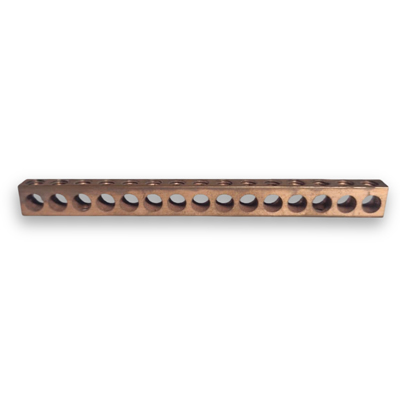
Material: Copper
Conductor Range: 4 AWG – 14 AWG
Number of Circuits: 13
Total Number of Holes: 15
Mounting Hole Positions: 3 and 13
Overall Length: 4.75 in.
Width: 0.33 in.
Height: 0.44 in.
Conductor Hole Spacing: 0.31 in.
Mounting Hole Spacing: 4.10 in.
Mounting Hole Specification: Through mounting holes sized for 1/4 in. bolt
Custom copper neutral bar for electrical panelboards, distribution panels, switchboards, and switchgear. The 13-circuit neutral bar accommodates 4 AWG-14 AWG conductors and has 15 total holes, with mounting holes at positions 3 and 13.
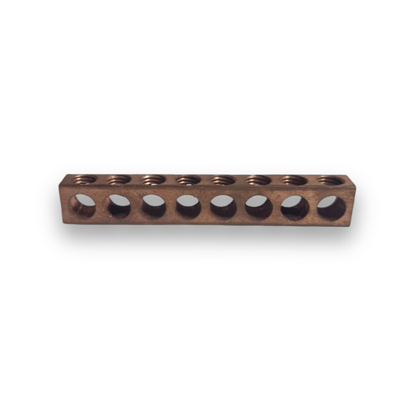
Material: Copper
Conductor Range: 4 AWG – 14 AWG
Number of Circuits: 6
Total Number of Holes: 8
Mounting Hole Positions: 2 and 7
Overall Length: 3.26 in.
Width: 0.37 in.
Height: 0.49 in.
Conductor Hole Spacing: 0.51 in.
Mounting Hole Spacing: 1.71 in.
This custom copper neutral bar is designed with 6 circuit positions and 8 total holes, including mounting holes at positions 2 and 7. It has a compact 3.26 in. overall length, with a 0.37 in. width and 0.49 in. height. The conductor connection holes are spaced at 0.51 in., while the mounting holes have 1.71 in. spacing. The bar is specified for 4 AWG-14 AWG conductors.
| Item | Details |
|---|---|
| Material | Copper |
| Common Grades | C11000, C10100, and customer-specified copper grades |
| Length / Width / Height | Custom according to customer drawing |
| Connection Positions | Custom according to circuit and conductor requirements |
| Hole Count | Custom number of holes according to customer drawing |
| Hole Diameter / Spacing | Custom hole diameter and spacing according to drawing |
| Thread Types | Metric, UNC, UNF, BSP, and customer-specified threads where required |
| Mounting Configuration | Through holes, tapped holes, custom mounting layouts |
| Surface Finish | Natural copper, tin plating, nickel plating, and other specified finishes where applicable |
Copper provides higher electrical and thermal conductivity than brass and aluminum. Copper neutral bars can provide higher electrical conductivity than aluminum and brass neutral bars. We also support customer-specified copper grades according to the drawing.
C11000 is electrolytic tough-pitch (ETP) copper with a minimum copper content of 99.90%. It has a listed electrical conductivity of about 101% IACS at 20°C, with a minimum conductivity of 100% IACS in the annealed condition. C11000 is widely used for electrical conductors and copper busbar applications.
C10100 is oxygen-free electronic (OFE) copper with a minimum copper content of 99.99% and approximately 101% IACS minimum electrical conductivity in the annealed condition. It is used for high-conductivity electrical applications.
C10200 is oxygen-free (OF) copper and is also used for electrical bus conductors and bus bars. It provides very high electrical conductivity, with 100% IACS minimum conductivity in the annealed condition.
| Copper Grade | Designation | Main Characteristic | Electrical Conductivity at 20°C | Machinability |
|---|---|---|---|---|
| C11000 | ETP Copper | High-conductivity electrical copper | ≈101% IACS | 20% |
| C10100 | OFE Copper | High-purity oxygen-free copper | ≈101% IACS | 20% |
| C10200 | OF Copper | Oxygen-free high-conductivity copper | ≈101% IACS | 20% |
| Property | C11000 Copper | C10100 Copper |
|---|---|---|
| Electrical Conductivity at 20°C | 101% IACS | 101% IACS |
| Thermal Conductivity | 226 Btu·ft/ft²·hr·°F | 226 Btu·ft/ft²·hr·°F |
| Machinability Rating | 20 | 20 |
Copper is a ideal choice when your main requirements are high electrical conductivity, thermal conductivity, and electrical performance over cost and weight. Copper neutral links are used in panelboards and power distribution equipment.
Copper provides much higher electrical conductivity than brass and many general-purpose aluminum alloys. This higher conductivity can help reduce electrical resistance and voltage drop for the same conductor size and operating conditions.
Copper also has high thermal conductivity, which helps it transfer heat through the conductor. Actual thermal performance depends on the copper grade, bar dimensions, current, temperature, and installation conditions.
Copper neutral bars are specified when the panel design requires copper neutral components, often because the equipment specification calls for copper current-carrying parts. Copper has high electrical conductivity, which can be useful where electrical performance is a priority.
The main difference is the conductor material. A 100% copper neutral uses copper for the neutral assembly, while the standard neutral in some panel boards may use aluminum neutral bar. Copper has higher electrical conductivity than aluminum, but copper is also heavier and generally more expensive. The correct choice depends on the equipment design and specified requirements.
A copper neutral bar can be used with aluminum conductors only when the terminal lug is specifically rated for aluminum conductors. The copper material of the bar does not by itself make the connection suitable for aluminum wire.
Generally, copper has a higher electrical conductivity than aluminum, so a copper conductor of the same cross-sectional area can have lower electrical resistance. However, you should not use material alone to assign a neutral-bar ampacity. Actual current-carrying capacity depends on bar dimensions, temperature rise, spacing, number of bars, surface emissivity, enclosure conditions, and the applicable equipment design.
Bar size has a direct effect on current-carrying capacity because the cross-sectional area and available surface area affect electrical resistance and heat dissipation. Larger busbars can generally carry more current, but the final ampacity also depends on temperature rise, spacing, number of bars, surface treatment, and installation conditions.
Check the material, overall dimensions, number of connection positions, conductor range, hole diameter, hole spacing, mounting-hole positions, mounting-hole size, thread details, and supplied hardware. The replacement must also be suitable for the specific panel. A physically similar bar is not automatically an approved replacement.
Yes. A copper neutral bar can be designed with different conductor ranges for different connection positions when the product design specifies them.
Nonlinear loads can produce harmonic currents in the neutral conductor. These currents can increase neutral heating, so some panelboard designs use a neutral rated at 200% of the panelboard phase rating for non-linear loads.
To request copper neutral bars quotation, send your product drawing and RFQ details.
Please include:
Send your RFQ and drawings to receive a quotation with pricing and indicative lead time.