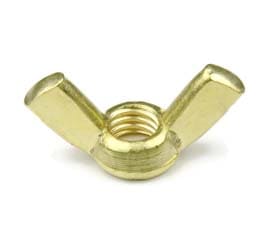
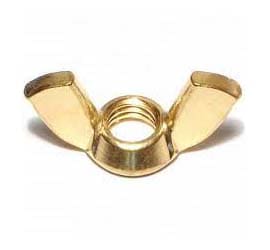
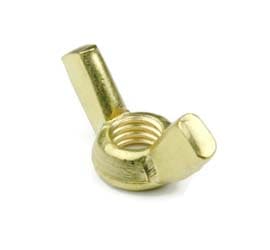
A brass wing nut is an internally threaded nut with two wing-shaped projections on opposite sides. The wings provide finger grip and leverage for tightening and loosening the nut by hand without a tool.
We are a custom brass wing nut manufacturer and supply brass wing nuts to OEMs, distributors, and industrial buyers in the United States, Asia, and across European markets, including Germany, France, Spain, the Czech Republic, the Netherlands, the UK, and Italy.
All our custom brass butterfly nut will be manufactured according to the customer's drawing and sample. Custom thread sizes, dimensions, thread systems, and designs according to customer requirements. Custom brass grades are supported according to customer requirements, along with both metric and imperial thread configurations.
We support medium- to high-volume production requirements. Samples and a small batch are also supported for quality and testing.
Request a Quote for Custom Brass Wing NutsThe internal thread of the wing nut engages with the external thread of a matching bolt, screw, or stud. When you rotate the nut by hand, it moves along the thread and brings the mating parts together to create clamping force. Turning the nut in the opposite direction moves it away from the mating parts and releases the joint.
We manufacture wing nuts in different wing shapes and body designs. Common wing nut forms are the American and German forms.
Brass American Form wing nuts have two relatively flat, less-rounded wings that provide finger grip for hand tightening and loosening. This form is commonly associated with the American-style wing profile and used for low-torque fastening applications.
Brass German Form wing nuts have larger, more rounded wings that provide a broad grip for hand tightening and loosening.
We manufacture custom brass wing nuts in low-wing, large-base designs. These variants change the wing profile, base size, and hand grip.
| Item | Specification |
|---|---|
| Brass Grade | Brass, including C36000, CW614N / CuZn39Pb3, IS 319 Grade I, and customer-specified brass grades |
| Wing Nut Types | Standard brass wing nuts, DIN 315 wing nuts, custom brass wing nuts according to drawing |
| Thread System | Metric, UNC, UNF, BSW, BSF, BA, customer-specified thread systems, and fitting-specific threads where required by the design |
| Thread Size | According to specified nominal diameter, pitch, TPI, thread series, thread class, and customer drawing |
| Surface Finish | Natural brass, polished brass, tumbled finish, tin plating, nickel plating, and customer-specified finishes |
| Tolerance | General tolerance ±0.10 mm, tighter tolerances according to drawing requirements |
| Inspection | Dimensional and thread inspection according to drawing requirements, using calipers, micrometers, thread gauges, and other suitable measuring equipment |
| Material Certification | Available on request according to order requirements |
| Drawing Formats | STEP, PDF, DXF, DWG, and customer-specified formats |
| Packaging | Poly bags, boxes, master cartons, pallets, and custom packaging |
| MOQ | Based on wing nut geometry, material grade, tooling, quantity, and production requirements |
| Lead Time | According to quantity and production requirements |
| Tooling Ownership | All tooling are customer-owned. Tooling is never reused for other customers |
For more details, please visit our main brass nut page.
We manufacture both metric and inch thread sizes as per customer requirements. Metric threads are specified by nominal diameter and pitch, and inch threads are identified by thread size and threads per inch.
| Thread Size | Pitch |
|---|---|
| M4 | 0.70 mm |
| M5 | 0.80 mm |
| M6 | 1.00 mm |
| M8 | 1.25 mm |
| M10 | 1.50 mm |
| M12 | 1.75 mm |
| M16 | 2.00 mm |
| M20 | 2.50 mm |
| M24 | 3.00 mm |
Note: The sizes shown are provided for reference based on DIN 315. Actual size availability, dimensions, and thread details may vary by product specification.
| Thread Size | Threads per Inch | Thread Series |
|---|---|---|
| #6-32 | 32 | UNC |
| #8-32 | 32 | UNC |
| #10-24 | 24 | UNC |
| #10-32 | 32 | UNF |
| 1/4-20 | 20 | UNC |
| 1/4-28 | 28 | UNF |
| 5/16-18 | 18 | UNC |
| 5/16-24 | 24 | UNF |
| 3/8-16 | 16 | UNC |
| 1/2-13 | 13 | UNC |
| 5/8-11 | 11 | UNC |
| 3/4-10 | 10 | UNC |
Note: The sizes shown are provided for reference based on ASME B18.6.9. Actual size availability, dimensions, and thread details may vary by product specification.
Brass wing nuts are suited to manually tightened, low-torque connections that need convenient adjustment, removal, and repeated assembly. Brass can provide benefits such as non-magnetic behavior and conductivity, with corrosion resistance.
Used in access panels, equipment covers, and service covers that need regular removal.
Some furniture applications use brass wing nuts where joints need convenient hand adjustment and removal. Brass is also suitable for visible fastening points where its appearance and corrosion resistance fit the product design.
Used in Drum kits and cymbal stands are examples of musical instrument hardware. They allow quick hand adjustment during setup and repeated removal during transport and storage.
Selected electrical and electronic equipment uses wing nuts. Their hand-operated design also allows convenient access to fasteners during installation and maintenance.
There is no universal tightening torque for brass wing nuts. Standard wing nuts are generally tightened by hand, while a specific application may require a defined torque based on the product design and joint requirements. Follow the manufacturer’s specified torque with the specified installation conditions when provided.
A washer is useful when the wing nut bears against a soft, painted, finished, thin surface, unless the nut design already provides a suitable bearing surface. It spreads the load and helps protect the mating surface. A separate washer may not be necessary when the nut design already provides a suitable bearing surface.
A brass wing nut can be paired with a stainless steel bolt, but the joint should be evaluated for galvanic corrosion when moisture is present. The risk depends on the specific metals and service environment. Isolation methods may be needed in corrosive conditions.
Brass wing nuts can be reused when permitted by the product specification and when the threads and wings remain undamaged. Inspect the nut before reuse and replace it if the threads are damaged, the wings are deformed, corrosion has affected the fastening surfaces.
A standard brass wing nut is not a locking nut. It is designed for manual tightening and removal. Applications that require additional resistance to loosening need a suitable locking method specified for the joint.
Brass wing nuts are designed primarily for hand tightening. Some wing nut designs can be operated with a compatible driver, but tool use should follow the product specification because excessive torque can damage the nut and threaded joint.
Check the complete thread designation of the mating bolt, including nominal size and pitch for metric threads and thread size with threads per inch for inch threads. Also check the wing nut dimensions when the available installation space is limited.
To request a brass wing nut quotation, send your drawing and RFQ details.
Please include:
Send your RFQ and drawings to receive a quotation with pricing and indicative lead time.
Request a Quote for Custom Brass Wing Nut