
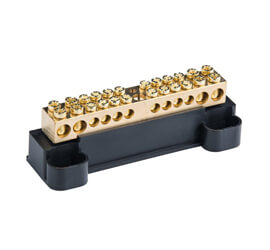

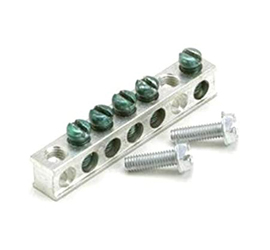
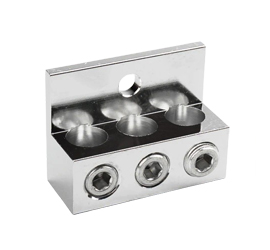
Neutral Bar Manufacturer - Custom Machined Brass, Copper, and Aluminum Neutral bar For USA, Europe, and Asia
We are an OEM custom neutral bar (neutral links) manufacturer and supplier based in India. We manufacture brass, aluminum, and copper neutral bars, along with related products such as terminal blocks and terminal lugs. We use CNC-controlled SPM machines designed for operations such as drilling, tapping, chamfering, and slotting on neutral bars.
We manufacture custom neutral bars according to customer drawings and samples, with different conductor ranges, mounting holes, terminal configurations, hole patterns, thread sizes, layouts, connection positions, lengths, widths, and designs. Neutral bars are used in electrical panels, switchgear, power distribution boards, and control panels.
Our customers include OEM electrical control board manufacturers, switchgear assemblers, and distributors across the USA, UK, Europe, and Asia. We support prototypes before production and prefer medium to bulk-volume orders over small, one-time production orders.
Request Quote Today For Custom Neutral BarWhat Is a Neutral Bar?
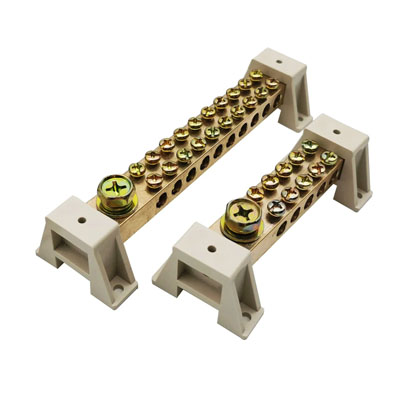
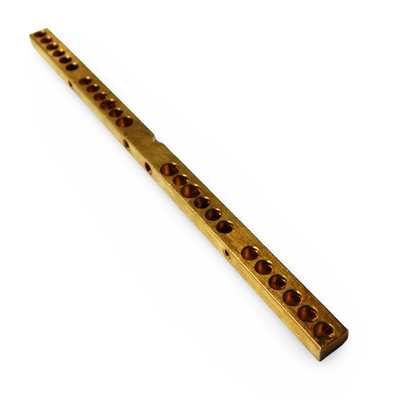
A neutral bar, also known as a neutral link, is a conductive metal bar used inside an electrical panel, switchboard, distribution equipment, and other electrical assemblies. A neutral bar connects multiple neutral conductors. Inside an electrical system, it provides a common connection point for neutral conductors.
Recent OEM Neutral Bar Projects
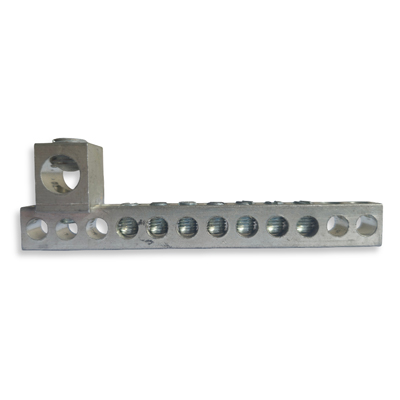
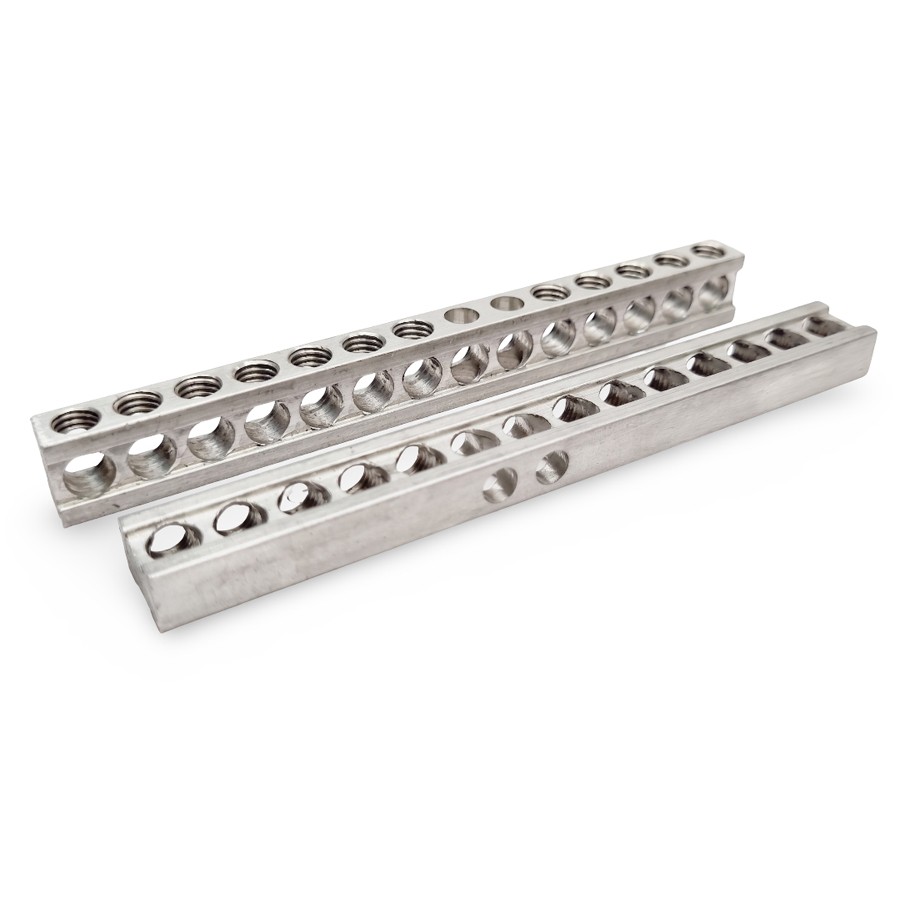
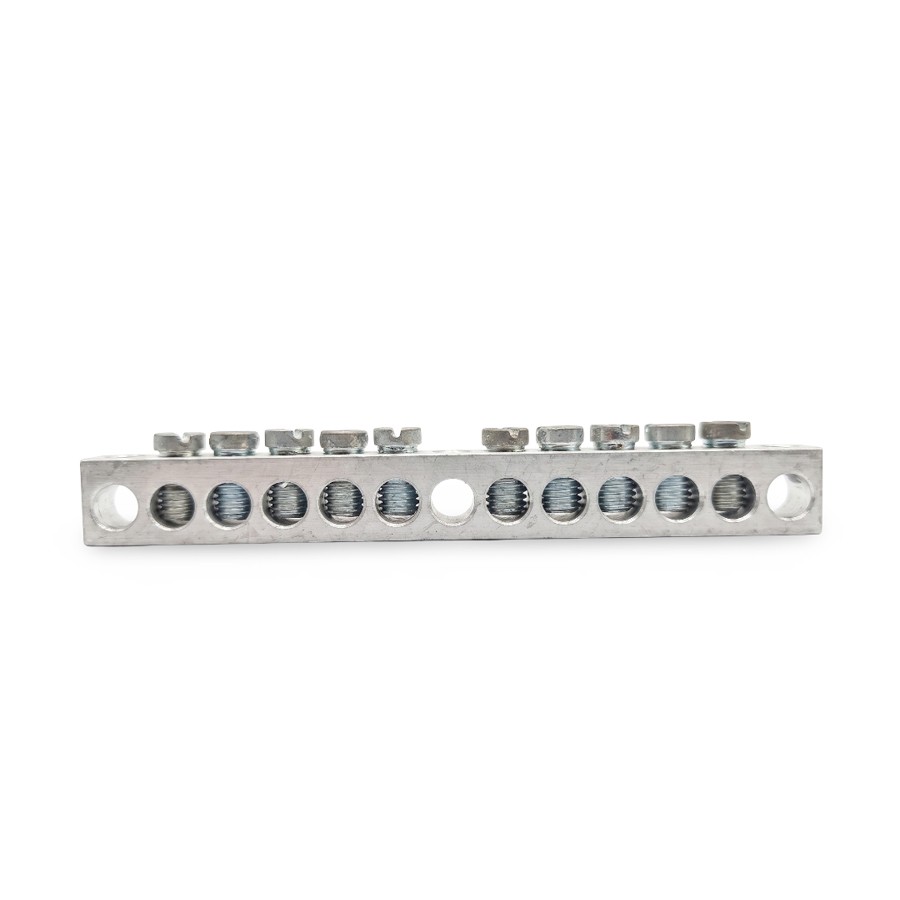
Custom Aluminum Neutral Bar with Lug
Material: Aluminum 6061-T6
Number of Circuits: 12
Conductor Range: 14 AWG – 4 AWG
Configuration: Aluminum Neutral Bar with Lug
Overall Length: 106 mm
Width: 9.50 mm
Height: 12.70 mm
Hole Diameter: Ø6.35 mm
Hole Spacing: 8.40 mm
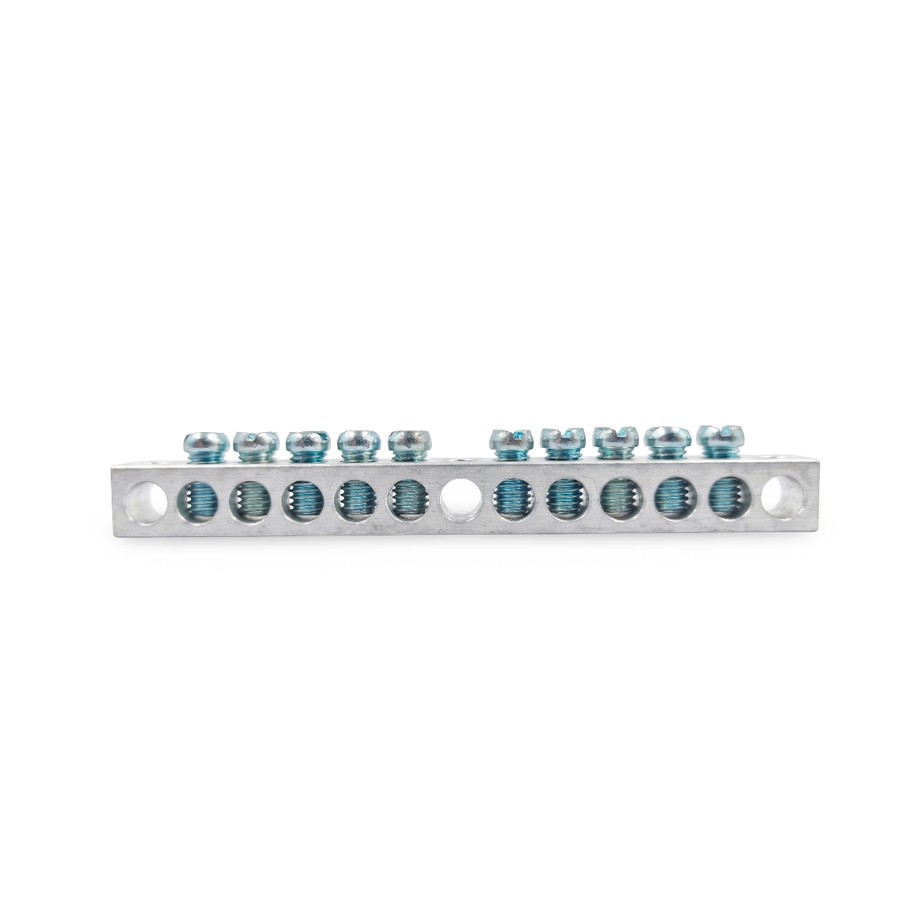
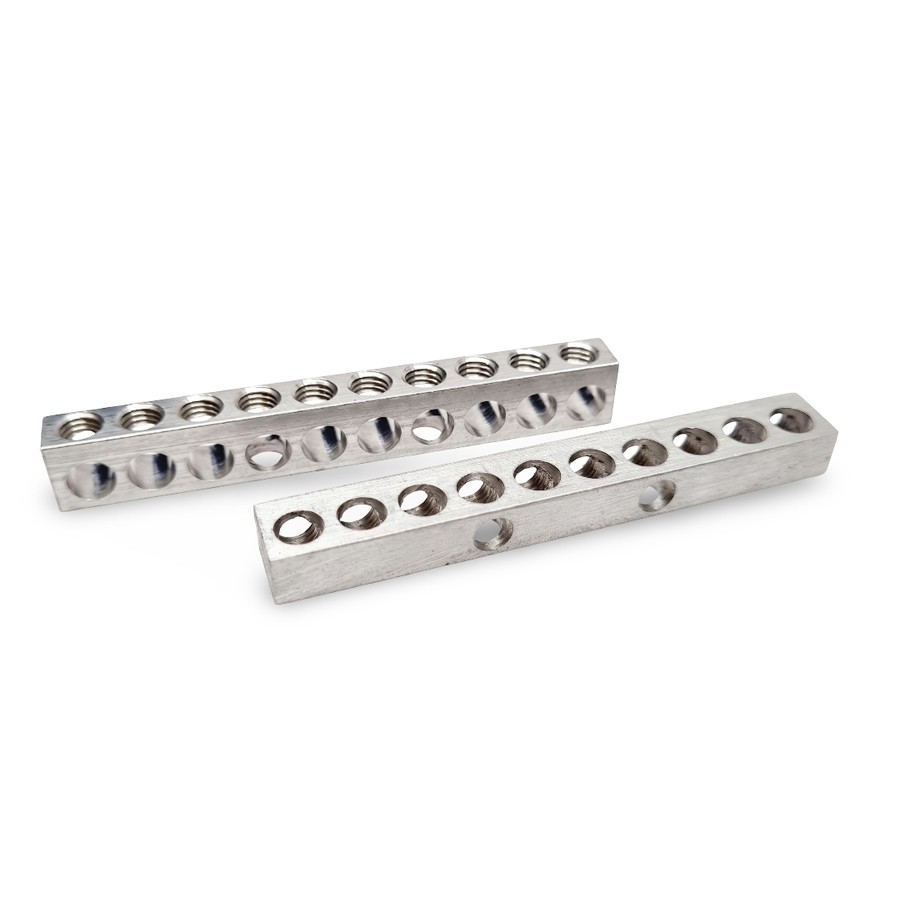
Custom 6061-T6 aluminum neutral bar with lug, designed for 12 circuits and a 14 AWG-4 AWG conductor range. The bar has an overall length of 106 mm, width of 9.50 mm, height of 12.70 mm, 6.35 mm hole diameter, and 8.40 mm hole spacing.
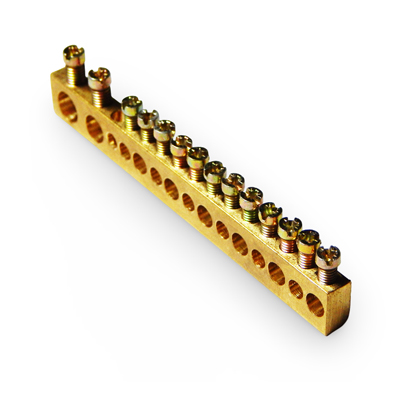
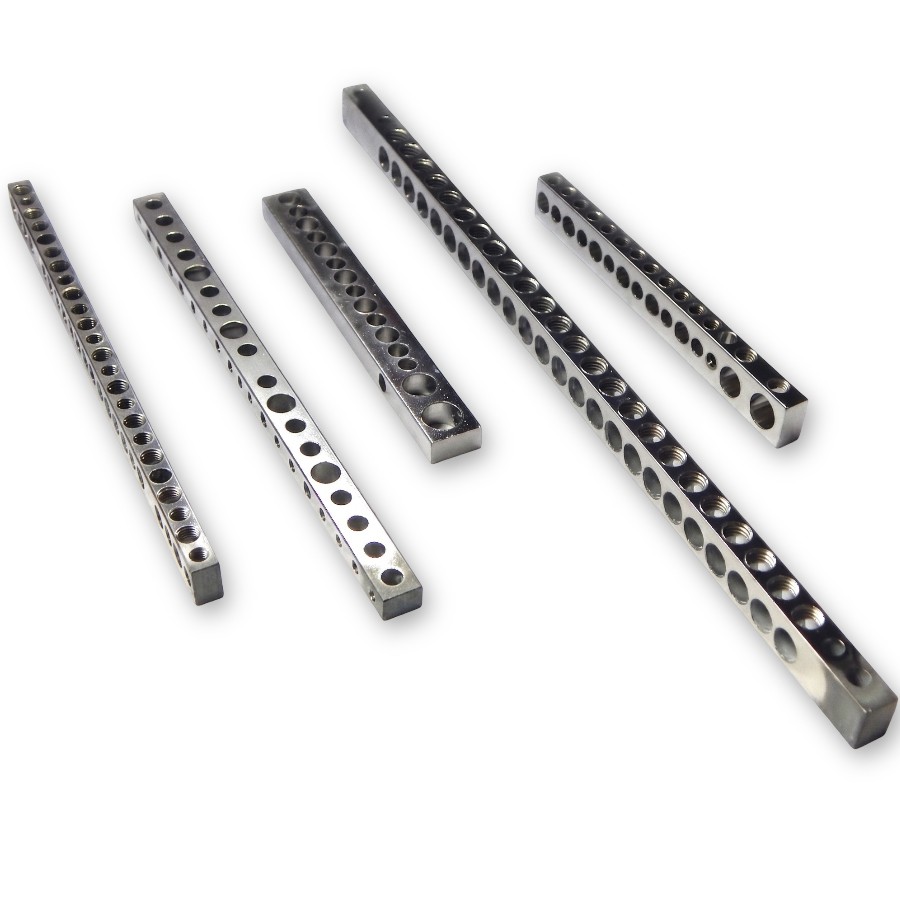
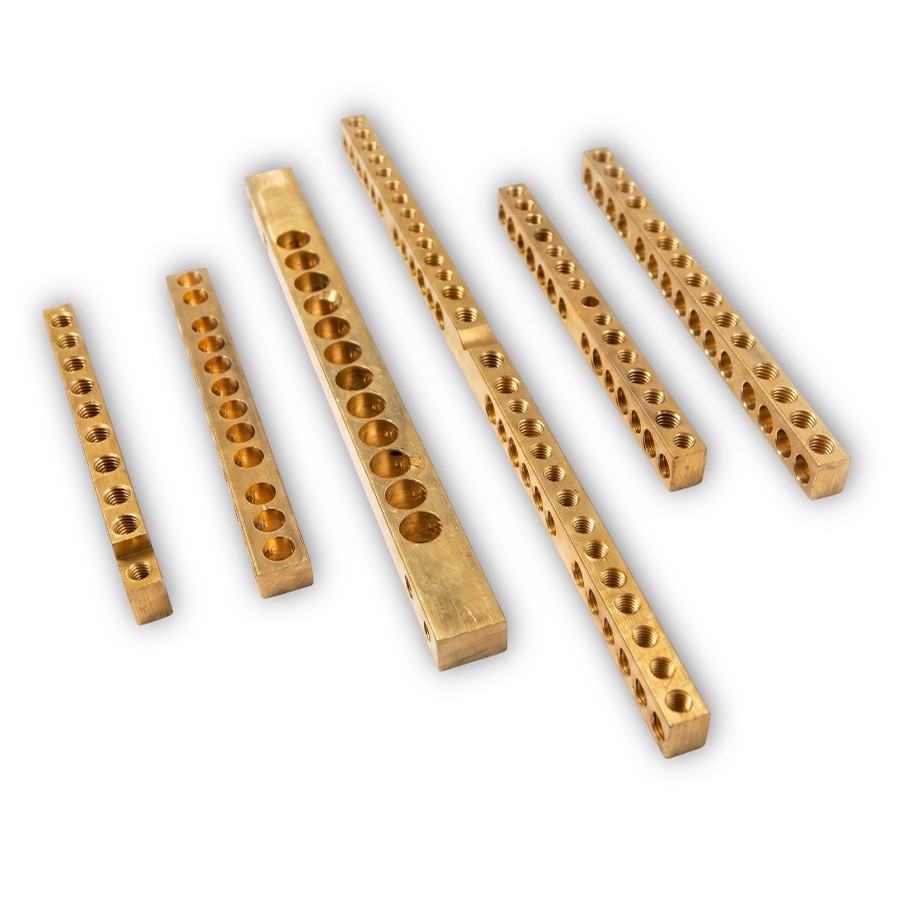
Custom Brass Neutral Bar with Multi-Size Connection Holes
Material: Brass IS 319 Free-Cutting
Total Number of Holes: 15
Total Number of Mounting Holes: 2
Mounting Hole 1: Ø8.30 mm
Mounting Hole 2: Ø7.0 mm
Connection Hole 1: Ø4.0 mm
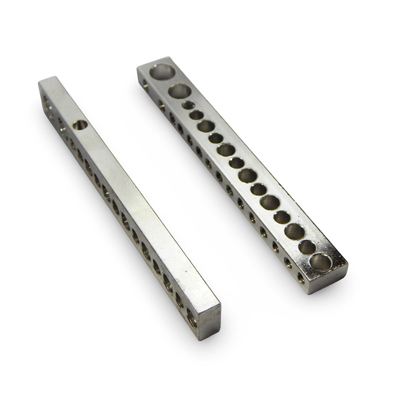
Connection Hole 2: Ø4.50 mm
Connection Hole 3: Ø5.40 mm
Thread Sizes: M5 and M4
Overall Length: 101 mm
Width: 6.50 mm
Height: 12.50 mm
Custom 6061-T6 aluminum neutral bar with mounting lug for electrical panel and distribution applications. This 12-circuit neutral bar accommodates 14 AWG-4 AWG conductors and measures 106 mm in overall length, 9.50 mm in width, and 12.70 mm in height. The bar has Ø6.35 mm connection holes with 8.40 mm hole spacing.
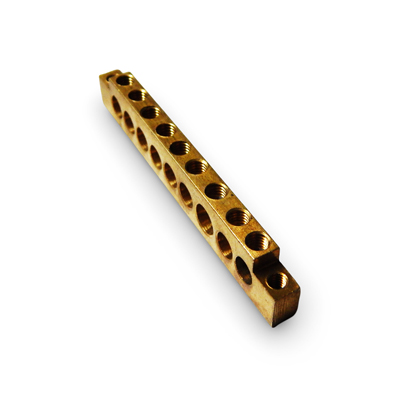
Custom Brass Neutral Link with Mounting Slots
Material: Brass
Total Number of Holes: 12
Total Number of Mounting Holes: 2
Mounting Hole Positions: 4th and 9th
Thread Size: M5
Number of Screws: 12
Overall Length: 121 mm
Width: 6.00 mm
Height: 12.90 mm
Connection Hole Diameter: Ø6.30 mm
Mounting Hole Diameter: Ø8.80 mm
Number of Mounting Slots: 2
Mounting Slot Height: 9.30 mm
Mounting Slot Thread: M3
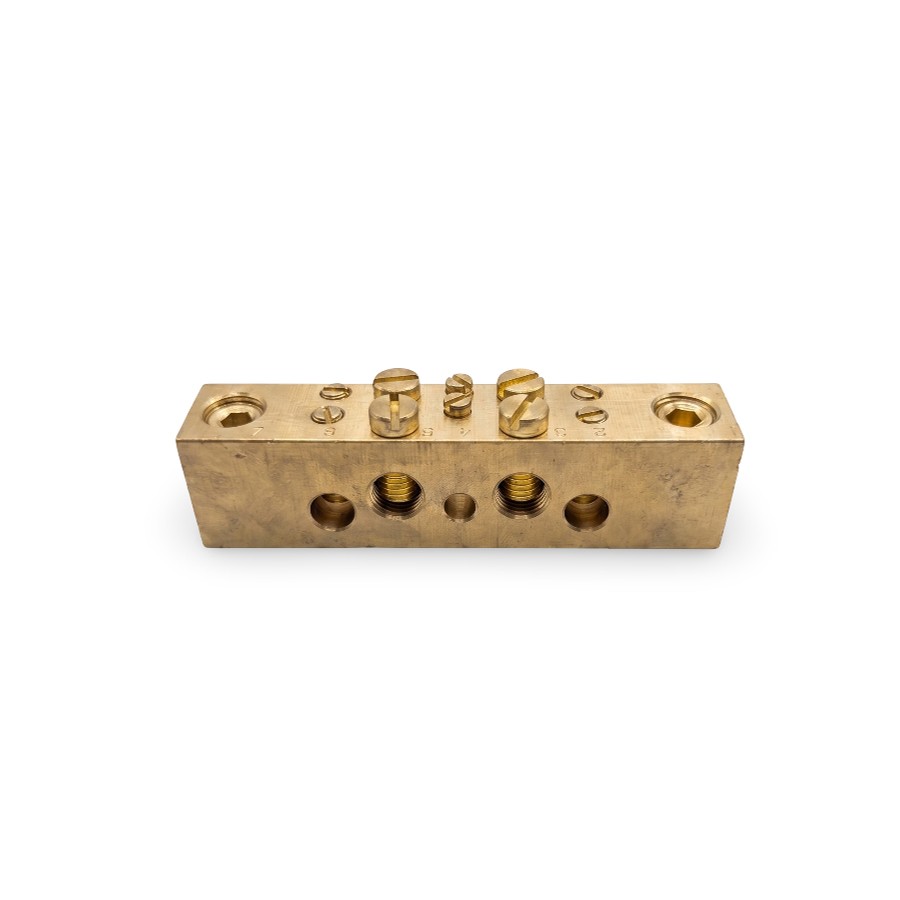
Custom brass neutral link with 12 threaded holes, 2 mounting holes, and 2 mounting slots for assembly. The neutral busbar has an overall length of 121 mm, 6.00 mm width, and 12.90 mm height, with Ø6.30 mm connection holes and Ø8.80 mm mounting holes at the 4th and 9th positions. The neutral bar uses M5 threads and 12 screws, with additional M3-threaded mounting slots for assembly.
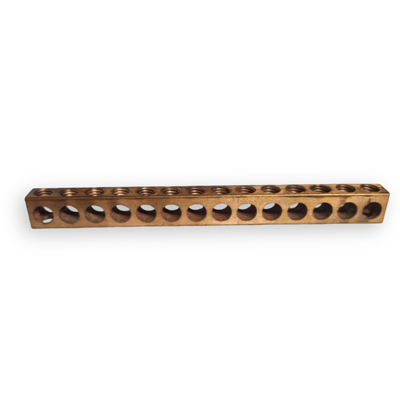
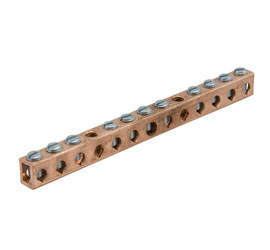
OEM Copper Neutral Bar with Multiple Hole
Material: Copper
Conductor Range: 4 AWG – 14 AWG
Number of Circuits: 12
Total Number of Holes: 14
Mounting Hole Positions: 1 and 14
Overall Length: 4.43 in.
Width: 0.33 in.
Height: 0.44 in.
Conductor Hole Spacing: 0.31 in.
Mounting Hole Spacing: 4.05 in.
Mounting Hole Specification: Through mounting holes sized for 1/4 in. bolt
Custom copper neutral bar for 12 circuits and a 4 AWG-14 AWG conductor range, with 14 total holes and mounting holes at positions 1 and 14. The bar has an overall length of 4.43 in., width of 0.33 in., and height of 0.44 in., with 0.31 in. conductor hole spacing and 4.05 in. mounting hole spacing. The mounting holes are through holes sized for the 1/4 bolts.
Neutral Bar Specifications & Capabilities
| Item | Details |
|---|---|
| Material | Brass, copper, aluminum, and customer-specified materials |
| Common Material Grades | Brass: C36000 and customer-specified grades; Aluminum: 6061-T6 and other customer-specified grades; Copper: customer-specified grades |
| Length / Width / Thickness | Custom dimensions according to customer drawing |
| Connection Positions | Custom number of connection positions according to conductor requirements and circuit configuration |
| Conductor Range | Custom conductor range according to the neutral-bar design and terminal configuration |
| Hole Pattern | Custom hole diameter, quantity, spacing, and location according to drawing |
| Thread Types | Metric, UNC, UNF, UNEF, BSP, NPT, NPTF, and customer-specified thread |
| Mounting Configuration | Through mounting holes, tapped mounting holes, different mounting-hole positions, mounting blocks, and custom mounting arrangements |
| Surface Finish | Natural finish, tin plating / electro-tin, nickel plating, anodizing for aluminum, and other customer-specified finishes |
| Tolerance | According to customer drawing and specified dimensional requirements; tighter tolerances reviewed case by case |
| Manufacturing Process | Cutting, drilling, tapping, chamfering, deburring, surface finishing, inspection, and other machining operations according to part requirements |
| Production Volume | Prototype / sample support before batch production; medium and repeat OEM production preferred |
| MOQ | Depends on drawing, part complexity, material, and production requirements |
| Lead Time | Approximately 2-4 weeks depending on order size, complexity, material, finish, and production requirements |
| Inspection Equipment | Vernier caliper, pin gauge, thread plug gauge, Go/No-Go gauge, and partner-provided CMM, surface roughness tester, and profile projector where required |
| Packaging | Bag, carton, pallet, and custom packaging |
| Drawings Accepted | STEP, PDF, DXF, and DWG files |
| Documentation | Material Certificate and Dimensional Inspection Report available on request |
Materials for Neutral Bars
Neutral bars are manufactured from different materials according to electrical, mechanical, and application requirements. Common materials for neutral bars are brass, aluminum, and copper. We provide different material alloy grades according to customer requirements.
Brass
Brass is cheaper than copper. Brass also provides good corrosion resistance and machinability. Brass threads can be suitable for repeated installation and maintenance. We commonly use free-cutting C36000 brass for brass neutral bar manufacturing and also support custom brass grades according to customer requirements. Brass neutral links are used in residential panels, industrial control panels, and distribution boards.
For more details, visit our Brass Neutral Bar product page.
Copper
Copper provides higher electrical and thermal conductivity. Copper can provide lower resistance and voltage drop than brass or aluminum. Higher conductivity and lower resistance can also help reduce heat generation under high current loads. Copper neutral bars can be selected when higher electrical conductivity is more important for the application.
For more details, visit our Copper Neutral Bar product page.
Aluminum
Aluminum neutral bars provide good electrical conductivity and lower weight compared with copper. Connection quality needs appropriate attention because aluminum surfaces naturally form an oxide layer. Aluminum can help reduce overall panel weight in applications. The electrical performance, mechanical properties, and connection requirements depend on the aluminum alloy and bar design.
For more details, visit our Aluminum Neutral Bar product page.
Comparison Table: Brass vs Copper vs Aluminum Neutral Bars
| Feature | Brass Neutral Bar | Copper Neutral Bar | Aluminum Neutral Bar |
|---|---|---|---|
| Common Material Grades | C36000, CZ121 | C10100 (OFHC) | 6061-T6, 6082-T6 |
| Electrical Conductivity | Moderate | Very High | Good |
| Machinability | Excellent | Lower | Good, depending on alloy |
| Corrosion Resistance | Excellent | Good | Good, with natural oxide protection |
| Typical Selection Factors | Machinability, threaded connections, corrosion resistance | High electrical and thermal conductivity | Lower weight, electrical conductivity, and strength-to-weight ratio |
| Finish Options | Natural, tin plating, nickel plating | Natural, tin plating, nickel plating | Natural, anodizing, plating where required |
| Thread Performance | High | good | Good |
| Weight (Density g/cm³) | 8.50 | 8.91 | 2.70 |
| Cost | $$ | $$$ | $ |
Types of Neutral Bars
We make custom neutral bars in different configurations, designs, hole patterns, connection positions, and mounting arrangements. Here are some common neutral bar configurations.
Single-Bar Neutral Links
A single neutral bar is a basic bar design with multiple conductor connection positions and mounting holes. It is used where a common neutral connection is required. Available in different lengths and numbers of connection positions according to application requirements.
Multi-Circuit Neutral Bars
Multi-circuit neutral bars provide multiple connection positions along one bar for terminating several neutral conductors. Hole and port arrangements are available according to the required conductor connections and circuit configuration.
Neutral Bars With Different Mounting Configurations
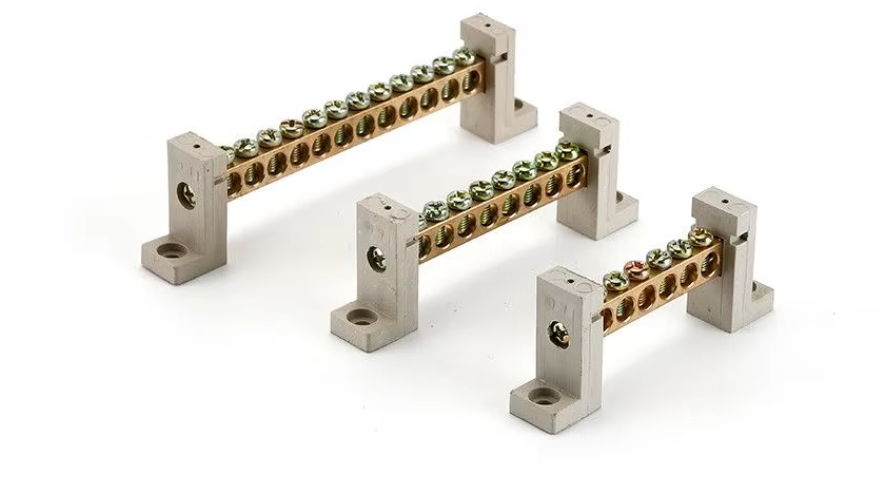
Custom neutral bars can be made with different mounting configurations, such as through mounting holes, tapped mounting holes, different mounting-hole positions, mounting blocks, and direct mounting.
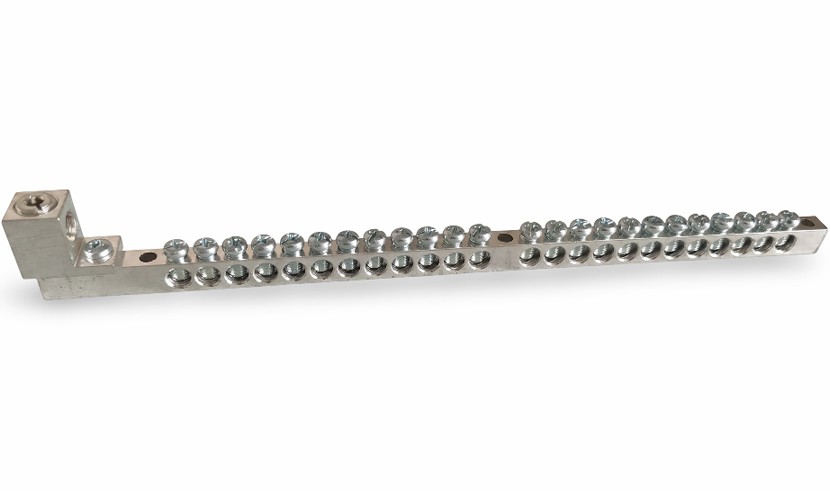
Neutral Bar Assemblies With Lugs
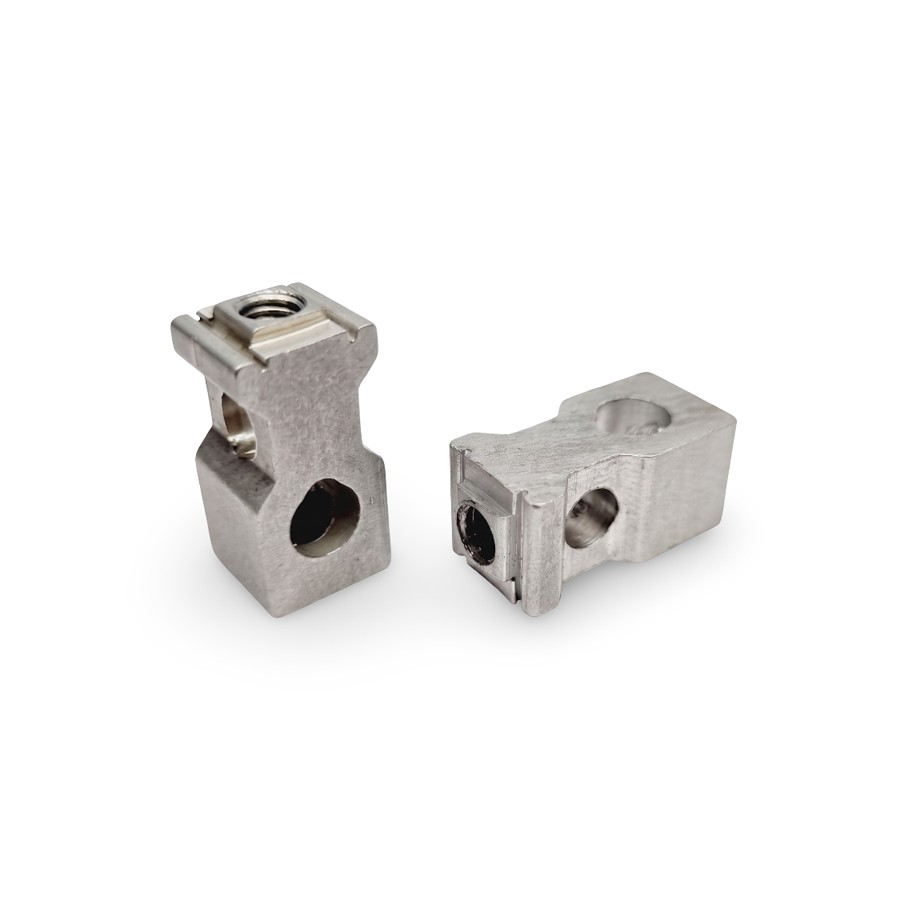
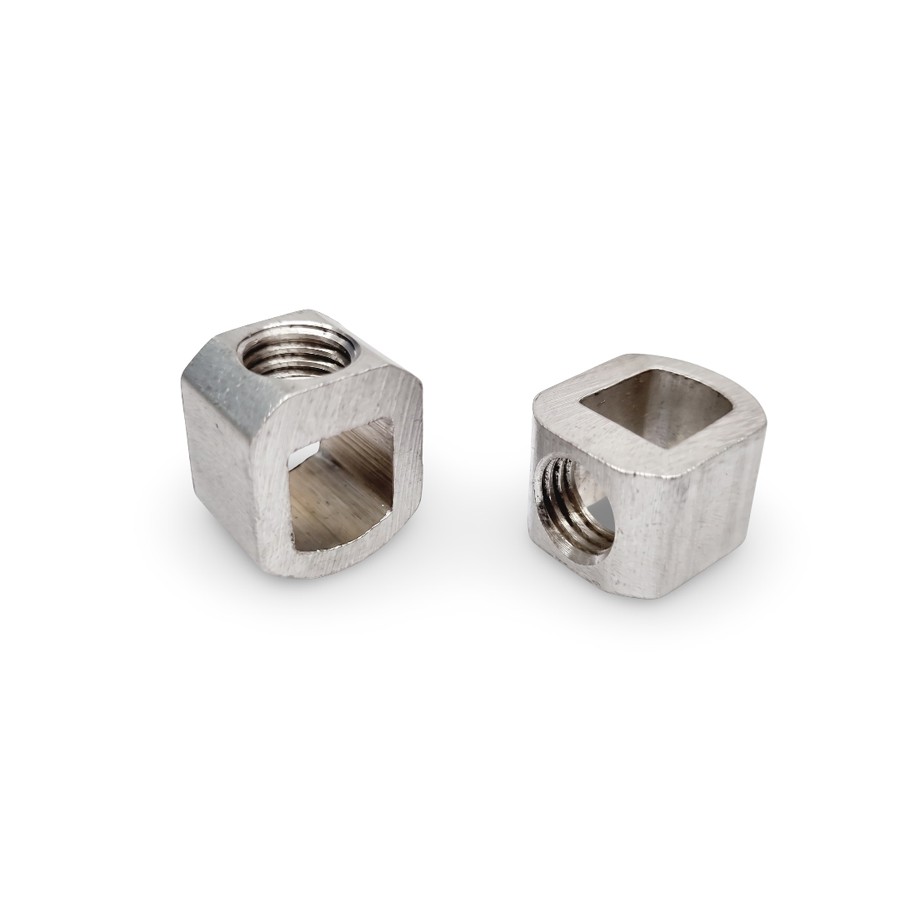
Neutral bar assemblies can include terminal lugs, screws, mounting bolts, mounting blocks, and other hardware according to the required configuration.
Stacked / Multi-Bar Neutral Assemblies
Stacked neutral bars use multiple neutral bars arranged as an assembly to provide additional connection positions within the available equipment space. The configuration depends on the assembly design.
Custom Neutral Bar Profiles and Layouts
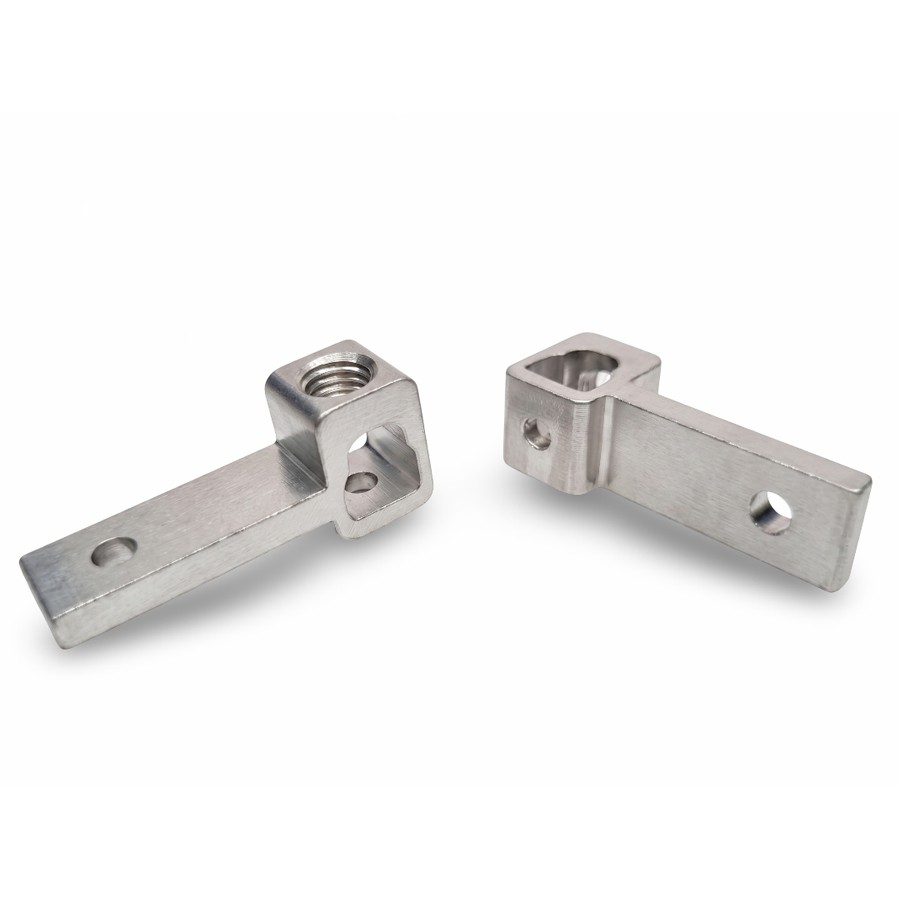
We manufacture custom neutral bars with flat profiles, aluminum I-section profiles, custom hole patterns, slots, threaded holes, different mounting holes, and customer-specific layouts.
Custom Neutral Bar Manufacturing Process
Our custom neutral bar manufacturing process includes material procurement, cutting, drilling, tapping, chamfering, deburring, surface finishing, final inspection, and packaging as required.
1. Raw Material Procurement
We source raw material from our trusted suppliers. Commonly, we use flat bar stock of aluminum, copper, and brass according to customer order requirements. In our manufacturing cycle, our first step is to buy raw material according to the required alloy, dimensions, and customer specifications.
2. Cutting
After raw material purchase and verification, we move to the second step of the process, cutting the bar stock to the required length according to the customer drawing using a cutting machine.
3. Drilling
Our third step after cutting is drilling for mounting and terminal holes using CNC-controlled SPM machines according to the specified hole diameter, spacing, and location.
4. Tapping
After verification and inspection of length and drilled holes, our fourth step is tapping the holes for internal threads. Threaded holes are tapped according to the required thread size, standard, and depth.
5. Chamfering & Deburring
After thread gauge verification, our final machining step is chamfering and deburring. Machined holes and edges are chamfered and deburred to remove sharp edges and machining burrs.
6. Cleaning & Surface Finishing
The finished neutral bars are cleaned and receive the required surface finish according to the material and customer requirements, such as anodizing for aluminum, tin plating and nickel plating where applicable.
7. Final Inspection
Finished neutral bars are checked against the customer drawing and required specifications before shipment.
8. Packaging
Finished neutral bars are packed according to customer packaging and shipping requirements.
Quality & Inspection
We check quality during production and before shipment according to customer drawings. Inspection covers key dimensions, holes, threads, flatness, and surface finish.
| Inspection Item | Inspection Method / Documentation |
|---|---|
| Hole Diameter | Pin gauges and vernier caliper |
| Hole Spacing / Position | Dimensional measurement |
| Overall Dimensions | Vernier caliper, micrometer, height gauge, and suitable measuring tools |
| Thread Inspection | Go/No-Go thread plug gauges |
| Flatness | Surface plate and suitable dimensional measurement, Checked when specified on the customer drawing |
| Surface / Finish Inspection | Visual inspection; additional inspection through partner, Checked when specified on the customer drawing |
| Surface Roughness | Surface roughness tester through partner when specified |
| Tin Plating Thickness | Coating-thickness measurement through partner when specified |
| Material Certificate | Available on request |
| Dimensional Inspection Report | Available on request |
Applications of Neutral Bars
Neutral bars are used in different electrical systems and industries. Neutral bars are used across commercial and industrial electrical distribution equipment, including distribution boards, panelboards, switchboards, switchgear, and control cabinets. The neutral-bar design, material, connection layout, and mounting arrangement depend on the equipment requirements.
Electrical Distribution Boards
Neutral bars are used in residential and commercial power distribution boards and building electrical distribution systems. Multiple branch neutral conductors are connected to a common neutral point. Neutral bars are available with different connection positions according to the circuit configuration.
Electrical Panelboards and Load Centers
Neutral bars are commonly used in panelboards and load centers for branch-circuit neutral termination and other neutral connections within the panel. Different neutral configurations are available according to the panel design, circuit count, and equipment requirements.
Switchboards and Switchgear
Neutral bars and neutral links are used in main distribution equipment for neutral bus connections, incoming service arrangements, and feeder connections. Removable neutral links can be used in specific switchboard arrangements where neutral isolation is required for testing and service.
Industrial Control and Distribution Cabinets
Neutral bars are used inside industrial electrical cabinets and control distribution enclosures for neutral conductor termination. Custom neutral bar used with different mounting holes, threaded holes, connection positions, and layouts according to the equipment design.
Neutral busbar systems with terminal blocks are also used in industrial control and distribution systems.
Terminal Block and DIN-Rail Distribution Systems
Neutral busbars are used with DIN-rail terminal systems in control cabinets and distribution applications. These systems can include neutral disconnect terminal blocks and supporting busbar arrangements for neutral conductor connections.
Neutral Bar FAQs
1. Can a neutral bar be used as a ground bar?
No, a neutral bar and a ground bar have different functions. A neutral bar is used to terminate neutral conductors, while a ground bar is used to terminate equipment grounding conductors and is connected to the equipment grounding system. In a downstream panel, the neutral bar is normally isolated from the panel enclosure and ground bar, so the neutral bar should not be used as a replacement for the ground bar. At service equipment, neutral and ground may be bonded, and some panel designs allow equipment grounding conductors to terminate on designated neutral terminals.
2. How do I choose the right neutral bar for my electrical panel?
The neutral bar should match the panel design, number of circuits, conductor sizes, number of required connection positions, mounting arrangement, and equipment requirements. The correct neutral-bar configuration should also be compatible with the specific panelboard and switchboard.
3. How many wires can be connected to a neutral bar?
There is no single number for all neutral bars. The permitted number depends on the specific bar design, number of listed terminals or ports, conductor size, conductor type, and manufacturer specifications. Commercial neutral bars are available with different numbers of usable ports and conductor configurations.
4. Does a neutral bar need to be isolated from the panel enclosure?
Not in every application. In a typical downstream panel, the neutral bar is isolated from the panel enclosure and equipment ground. At service equipment, the neutral may be bonded to the enclosure as required by the electrical system and applicable code. The correct arrangement depends on where the panel is installed.
5. Can neutral bars be supplied with screws, lugs, or mounting hardware?
Yes, depending on the product configuration. Neutral-bar assemblies can include connection screws, mounting hardware, lugs, connectors, and other specified components.
6. Can a neutral bar accept both copper and aluminum wires?
Some neutral bars are specifically rated for both copper and aluminum conductors. The bar and its terminals must be listed for the conductor materials being used.
7. Can I add another neutral bar if the existing neutral bar is full?
It depends on the specific panelboard and equipment. An additional neutral bar cannot simply be added because the existing bar is full. The panel manufacturer must permit the additional bar or provide an approved accessory for that equipment.
8. What is the difference between a neutral bar and a removable neutral link?
A neutral bar normally provides multiple connection points for neutral conductors. A removable neutral link is a specific component used in some switchboards to disconnect the neutral bus from the grounded service neutral conductor, such as for testing.
9. Does a neutral bar need tin plating?
Not every neutral bar requires tin plating. The required finish depends on the bar material, conductor compatibility, connection design, environment, and equipment requirements. Some commercial aluminum neutral bars are electro-tin plated and dual-rated for copper and aluminum conductors, while other neutral-bar designs may use a different plating.
10. What's the Difference Between a Neutral Bar and an Earth Bar?
A neutral bar connects neutral wires in an electrical panel. An earth bar connects protective earth and grounding wires. They have different electrical functions. In a typical downstream panel, the neutral bar is kept separate from the earth bar and metal enclosure. At service equipment, the neutral may be bonded to the enclosure as required by the electrical installation.
Request a Custom neutral bar Quote
To request custom neutral bars quotation, send your product drawing and RFQ details.
Please include:
- Material
- Quantity requirement (one-time, repeat, or blanket order)
- Surface finish requirement
- Required delivery timeline
- Shipping terms (EXW, DAP, or DDP)
Send your RFQ and drawings to receive a quotation with pricing and indicative lead time.