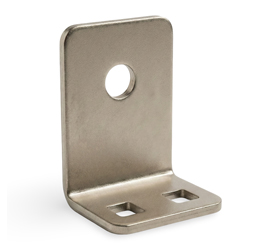
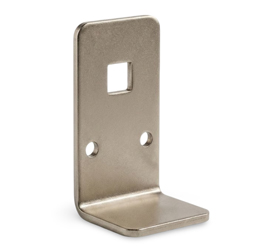
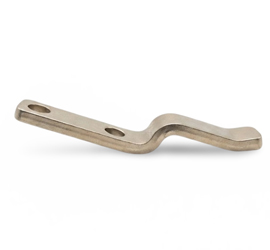
We manufacture custom sheet metal parts in India for Australian industrial buyers based on customer drawings and fabrication requirements. Production covers laser cutting, bending, forming, welding, and assembly work according to part geometry and order scope.
The process is commonly used to produce brackets, panels, enclosures, frames, covers, supports, and other fabricated sheet metal components.
Our work focuses on custom fabricated parts, repeat production batches, and OEM sheet metal supply rather than standard catalog items. We process stainless steel, mild steel, aluminium, and brass based on specified thickness and fabrication method.
Each drawing is reviewed before quotation. We check material, fabrication sequence, dimensional points, and packing requirements before production starts.
For full fabrication capability, material options, and process details, refer to our main sheet metal fabrication page.
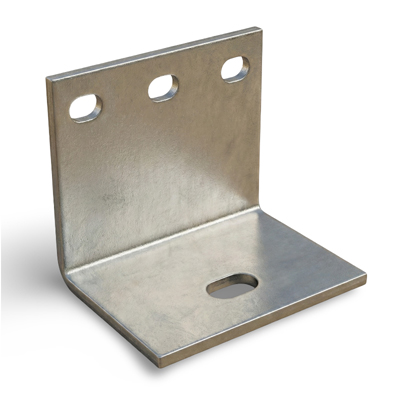
Custom sheet metal bracket was fabricated from 11 gauge pre-galvanised G90 steel sheet with a material thickness of 3.05 mm. Press brake forming was used to produce the 90-degree bend, followed by edge deburring, while the original mill-applied zinc coating remained unchanged without additional surface treatment.
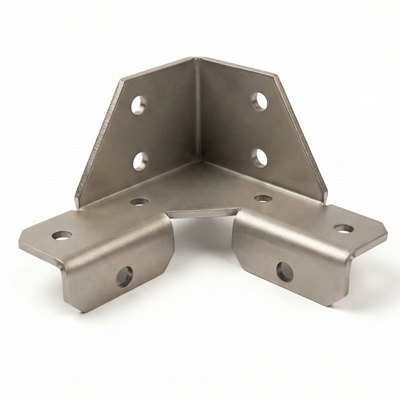
OEM sheet metal gusset was produced from G90 galvanised steel in 12 gauge thickness, 0.105 in, 2.67 mm, using dedicated forming dies for repeatable bend accuracy. Multiple 90° bends with controlled radii were formed during production, followed by edge deburring while the original galvanised surface remained unchanged for corrosion protection in structural reinforcement and panel support assemblies.
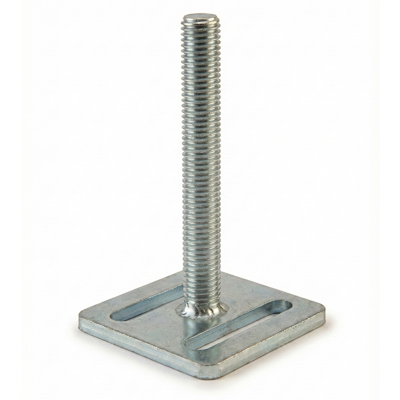
Bolt-down foot assembly was fabricated from laser-cut steel plate with elongated mounting slots for base adjustment during installation. A standard M12 × 1.75 threaded stud was fillet welded to the plate before zinc plating, providing corrosion protection for use as an anchoring point in industrial equipment and fixture assemblies.
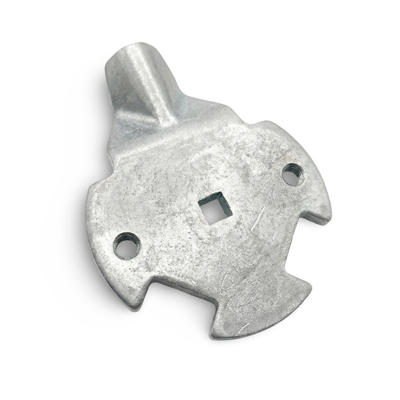
Offset centre cam was formed from steel sheet and zinc plated after production for corrosion protection. The part was designed for 8 mm square shaft handle systems used in panel doors and enclosure locking assemblies where controlled cam movement is required for secure closing.
We perform laser cutting to produce flat sheet metal parts with required profiles, slots, and cut openings. Punching is carried out using manual and press-based operations depending on part size and production requirement.
Custom metal stamping is used for repeat-production parts that require consistent geometry. Stamping is performed with dedicated tooling for blanking and piercing followed by secondary forming where required.
Bending is carried out using manual forming and CNC press brake bending for simple bends and repeatable formed parts. Forming and hemming are used for panels, covers, and enclosure components where edge strength and fold accuracy matter.
We support MIG welding, TIG welding, and spot welding for fabricated steel, stainless steel, and aluminum parts. Secondary work such as tapping, countersinking, Threaded insert, and nut installation is completed according to drawing requirements.
Surface finishing such as powder coating, anodizing for aluminum parts, and plating is arranged through qualified partner facilities when specified. Assembly and kitting are also supported for projects that require complete fabricated sets.
We review each drawing before quotation. Material thickness, cut profile, bend details, welding points, and fabrication sequence are checked before production is confirmed.
We support sample fabrication, batch orders, and repeat production against approved drawings. Minimum quantity depends on part size, fabrication steps, and tooling involved.
Repeat orders follow the same approved drawing and fabrication method used in earlier batches. Shipments are planned according to order volume, packing requirement, and agreed delivery terms.
Material selection follows drawing specification, thickness requirement, bend geometry, welding method, and surface finish requirement. Different sheet materials behave differently during cutting, bending, welding, and forming, so production settings are adjusted before fabrication starts.
We process stainless steel grades 304 and 316 for sheet metal fabrication. Common parts include enclosures, panels, and structural components. Typical thickness range is 0.3 mm to 3.0 mm. Stainless steel shows higher springback during bending, so bend angle control depends on tooling and forming sequence.
We process mild steel grades such as CRCA and hot rolled mild steel for general fabrication work. These materials bend more predictably than stainless steel. Typical thickness range is 0.8 mm to 6.0 mm. Thin sections may distort during welding, so fixture control remains important.
We process aluminum grades 5052, 6061, and 6063 based on drawing requirement and forming difficulty. Grade 5052 forms more easily than 6061 in parts with tighter bends. Typical thickness range is 1.0 mm to 4.0 mm. Bend radius control is important in 6061 to avoid cracking.
Galvanized and pre-coated sheets are used for panels, covers, and enclosure parts. Typical thickness range is 0.6 mm to 2.0 mm. Bending requires care to reduce coating damage, especially near fold lines.
Brass is mainly used for stamped parts and small electrical components such as terminals. It forms easily but surface marking must be controlled during handling. Thickness usually remains below 3.0 mm for stamping work.
We produce sheet metal parts against approved drawings for repeat OEM orders and scheduled production batches. Fabrication steps are finalized after first approval so cut profile, bend sequence, welding points, and assembly details remain consistent in later production.
Tooling and fixtures are prepared according to part requirement where repeat volume justifies dedicated setup. Batch supply follows the same approved fabrication method unless a drawing revision is received.
Secondary work such as tapping, insert fitting, and sub-assembly is completed when specified in the drawing.
To request a quotation, send your drawing, RFQ details, and fabrication requirements. PDF drawings are accepted for standard parts, and STEP files help where bends, assemblies, or formed details require review.
Please include:
After receiving the RFQ, we review drawing details and fabrication scope before quotation. If clarification is required, we contact the customer before issuing price, estimated lead time, and shipment details.