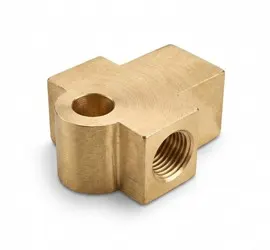
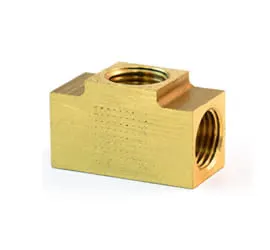
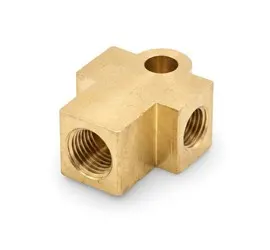
A brake line tee is a three-port fitting that creates a branch in a hydraulic brake line circuit. Two ports form the main run, and the third port connects a branch brake line. Some designs use a threaded branch connection. Brake line tees are commonly manufactured from brass and steel.
We are a leading brake line tee fittings manufacturer and supply brake tees to OEMs, distributors, manufacturers, and industrial buyers in the United States, Asia, and across European markets, including Germany, France, Spain, the Czech Republic, the Netherlands, the UK, and Italy.
All our custom brake line tees will be manufactured according to the customer's drawing and sample. We manufacture both male and female tees with bubble flare and inverted flare connections. We support custom materials, including brass and steel for brake line tee fittings. Common sizes are 1/4 brake line tee and 3/16 brake line tee. Both thread configurations are supported, including imperial (inch) and metric (mm).
We support medium- to high-volume production requirements. Samples and a small batch are also supported for quality and testing.
Request a Quote for Custom Brake Line Tee FittingsWe manufacture brake line tee fittings in different port arrangements, tube sizes, and mounting designs according to customer drawings. The tee connects three brake line paths through a common junction, and some designs include an additional threaded port for a pressure switch.
A brake line union tee connects three brake line sections at a common junction, and a common design has three female inverted-flare ports that accept brake tubes with tube nuts. We offer equal-size port configurations, and they are also available with different connection sizes. Union tees can include an integrated mounting bracket.
A trailer brake tee connects hydraulic brake lines within a trailer braking system. A common configuration has two female connections and one male connection. Many designs use the same tube size at all three ports, and some combine different tube sizes.
We offer trailer brake tees with inverted-flare connections, and we also offer metric designs with bubble-flare connections.
A brake line adapter tee combines two brake tube connections with a threaded branch connection. The tube connections commonly use inverted-flare seats, and the branch port uses a male threaded connection. Some designs use a female threaded branch.
An unequal-size brake line tee connects brake tubes with different outside diameters. The three ports can accommodate different tube sizes within the same fitting. For example, a tee can connect two 3/16-inch brake tubes to a 1/4-inch brake tube.
Some brake line tees include an integrated mounting bracket with a mounting hole. The bracket provides a fixing point for installation on a vehicle frame, axle assembly, and mounting support.
Some brake tee designs combine a 37-degree AN male branch connection with inverted-flare connections on the two main run ports. This arrangement connects an AN brake hose assembly to the brake line circuit.
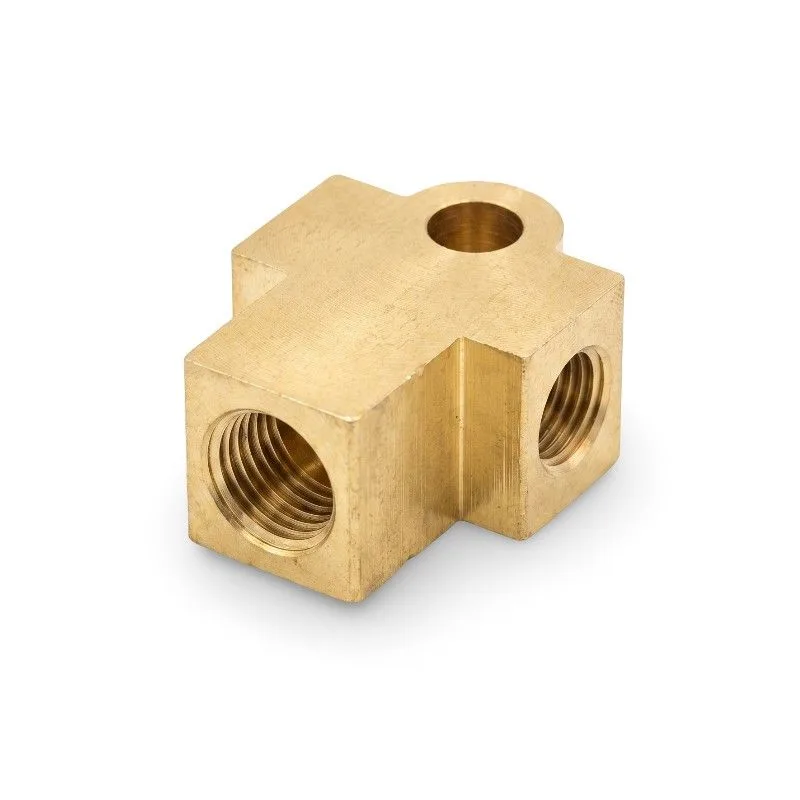
Material: Brass IS 319 Free Cutting
Fitting Type: Brake line tee / junction block
Top Connection: 3/8-24 female inverted flare
Side Thread Connections: 3/16-inch thread, 2 ports
Hole Diameter: Ø7 mm
Top Section Width: 14.6 mm
Overall Height: 31.65 mm
Component Weight: 49 g
We manufacture this custom brass 3/16 brake line tee according to the customer drawing, with a 3/8-24 female inverted-flare connection, two 3/16-inch threaded side connections, and a Ø7 mm hole. The brass fitting measures 31.65 mm in overall height and 14.6 mm across the top section, with a component weight of 49 g.
A brake line tee can have different connection specifications across its three ports. Each port needs its own tube size, flare type, thread diameter, thread pitch, and connection type.
SAE inverted-flare connections use a double-flared brake tube end. The tube nut draws the flared end against the inverted seat inside the tee to form a metal-to-metal seal. The 45-degree designation describes the tube flare geometry.
ISO 4038 specifies simple-flare pipes, tapped holes, male fittings and hose-end fittings for hydraulic braking systems in road vehicles. Commonly, this connection is a bubble flare.
The formed tube end has a rounded profile that seats against the matching surface inside the tee. The tube nut holds the tube against this seat to form a sealed connection.
For example, one metric brake tee design uses M12 × 1.0 bubble-flare connections on two ports and a 3/8-24 inverted-flare connection on the third port.
Brake line tees use different thread sizes according to their tube connections and threaded branch ports. The following table lists examples.
| Thread family | Example thread sizes | Connection details |
|---|---|---|
| Inch-based UNF | 3/8-24, 1/2-20, 5/8-18 | Used with inch-based inverted-flare tube connections. |
| Inch-based UNS | 7/16-24 UNS | Used with inch-based brake fitting connections. |
| Metric | M10 × 1.0, M12 × 1.0 | Used with metric brake tube connections. |
| NPT | 1/8-27, 1/4-18 | Tapered pipe threads used on branch and auxiliary ports. |
| NPTF | 1/8-27, 1/4-18 | Dryseal tapered pipe threads used on male and female branch connections. |
In inch-based thread designations, the first number identifies the nominal thread diameter, and the number after the hyphen identifies threads per inch. For example, 3/8-24 UNF has a nominal 3/8-inch thread diameter and 24 threads per inch.
Metric thread designations use the nominal diameter in millimetres followed by the thread pitch. M10 × 1.0 identifies a 10 mm nominal diameter and a 1.0 mm pitch.
NPT and NPTF are different tapered pipe-thread specifications.
Brake line tees use different combinations of male and female connections. The connection gender describes the threaded end at each port.
A common arrangement has two female inverted-flare connections and one male inverted-flare connection. Some designs use two inverted-flare connections with a male branch. Other configurations use a female branch.
The thread size can also differ between ports, even when the tube outside diameter remains the same.
Here is an example of brake line tee arrangements.
| Port | Example 1: Inverted-flare tee | Example 2: Metric brake tee |
|---|---|---|
| A | Female, 1/4-inch tube, 7/16-24 UNS, inverted flare | Female, 3/16-inch tube, M12 × 1.0, bubble flare |
| B | Female, 3/16-inch tube, 3/8-24 UNF, inverted flare | Female, 3/16-inch tube, 3/8-24 UNF, inverted flare |
| C | Male, 1/4-inch tube, 7/16-24 UNS, inverted flare | Male, 3/16-inch tube, M12 × 1.0, bubble flare |
Some brake tee designs have three brake line connections and an additional threaded port for a pressure-activated brake light switch.
For example, this configuration has three 3/8-24 female inverted-flare ports, a 1/8-27 female NPT switch port, and a 7/16-inch mounting hole. This design has four openings: three brake line ports and one switch port.
Some brake tee designs use a 37-degree AN connection at the branch. These fittings can also have inverted-flare connections on the two main run ports. The AN connection uses a 37-degree sealing surface.
We manufacture brake line tees according to customer drawings and material grade.
We manufacture brass brake line fittings and brass brake line tees as per the customer's requirements mentioned in the drawing. If the brass grade is not mentioned in the product drawing, then our default brass grade is IS-319 Grade I free-cutting brass. UNS C36000 is a recognized U.S. free-cutting brass grade, and CW614N / CuZn39Pb3 is a European free-machining brass grade.
Carbon steel brake line fittings tees are used in OEM brake line systems and high-strength brake connections. Zinc-coated and plated brake line fittings are common in brake line assemblies. Steel gives better strength and thread durability compared to brass. Steel is not rust-proof, so coating and plating become important.
| Item | Specification |
|---|---|
| Material | Brass and Steel |
| Manufacturing Process | CNC turning, machining, threading, milling, secondary machining, cold forming, forging, and machining of forged blanks according to the nut design |
| Thread System | Metric, UNC, UNF, BSP, BSW, BSF, BA, NPT, fitting-specific threads, and customer-specified thread systems |
| Thread Size | According to the specified nominal diameter, pitch, TPI, thread series, and customer drawing |
| Tee Design | SAE inverted flare and ISO/DIN bubble flare |
| Surface Finish | Natural brass, tin plating, nickel plating, zinc plating finish, and customer-specified finishes |
| Tolerance | General tolerance ±0.10 mm, tighter tolerances according to drawing. |
| Inspection | Dimensional and thread inspection according to drawing requirements, using calipers, thread gauges, and other suitable measuring equipment |
| Material Certification | Available on request according to order requirements |
| Drawing Formats | STEP, PDF, DXF, DWG, and customer-specified formats |
| Packaging | Poly bags, boxes, master cartons, pallets, and custom packaging |
| MOQ | Based on part geometry, material, tooling, quantity, and production requirements |
| Lead Time | According to quantity and production requirements |
| Tooling Ownership | All tooling are customer-owned Tooling is never reused for other customers |
Brake line tees distribute hydraulic brake fluid to the left and right wheel brakes. The main brake line carries fluid from the actuator to a tee mounted near the axle. The tee connects to separate brake lines that run to each wheel-end brake assembly.
Tandem and triple-axle trailer systems can use additional tees to distribute brake fluid to the brake assemblies on each axle. Some layouts connect a flexible brake hose from the trailer frame to the axle tee, then use separate rigid brake lines to connect the tee to the wheel cylinders.
Trailer hydraulic brake systems use tee fittings to divide the main brake line supply between individual wheel brakes. The tee can connect to a flexible brake hose from the actuator side and separate brake lines leading to the wheel brakes.
On axle-mounted designs, the tee provides a common connection point for the incoming hydraulic hose and the left and right brake lines. The fitting can use an integrated mounting hole to secure it to the axle assembly.
Some hydraulic brake circuits use a tee fitting to connect a pressure-operated brake light switch. The tee has an additional threaded port for the switch, while its remaining ports connect to the brake lines.
Brake pressure monitoring systems also use tee adapters at the master cylinder brake line connections. The original vehicle brake lines connect to the tee adapters, and additional brake pipes connect the remaining ports to hydraulic pressure sensors.
Some supplemental braking systems use a tee fitting to connect a proportioning valve to an existing hydraulic brake line. The tee can connect near an existing brake line union. Some installation layouts place it at the junction between a steel brake line and a flexible brake hose.
A separate brake line connects the tee to the proportioning valve. The tee configuration must match the vehicle's existing brake line connections and the specified installation layout.
Some industrial vehicles use brake line tees to distribute hydraulic pressure between connected service brake circuits. In certain lift truck designs, the main brake line runs from the master cylinder to a tee near the front of the frame. Separate left and right brake lines run from the tee to the transaxles.
Some truck braking systems also use dedicated tee adapters in their front-wheel brake circuits. These fittings connect multiple hydraulic brake lines at a common junction.
No. SAE inverted double flares and ISO bubble flares have different seating profiles. Each flare needs a matching seat inside the fitting. A mismatched connection can leak even when the threads fit.
A standard brake line tee connects three brake line ports through matching flare connections. Some branch tees include an additional NPT port for a hydraulic brake light switch or pressure gauge.
Yes. Some vehicle brake systems use a tee near the rear axle to split one supply line into separate lines for the left and right rear brakes.
A leak can start when the flare does not match the fitting seat. A misaligned brake tube can also prevent the flare from seating correctly. Damaged threads, damaged flare surfaces, and incorrect tightening can add to the problem.
Yes. A 3/16-inch brake tube commonly uses 3/8-24 inverted-flare threads. Some applications use M10 × 1.0 threads. Certain fittings also use larger tube-nut threads on smaller brake lines.
Yes. Some brake line tees have three matching ports. Other designs combine different thread sizes and connection types.
No. A 37-degree AN flare and a 45-degree inverted flare have different seating angles. Each connection needs a matching flare and seat. Matching threads alone cannot make these connections compatible.
No. The tube flare seals against the matching seat inside the tee. The threads hold the tube flare against that seat. Do not apply PTFE tape or thread sealant to inverted-flare connections.
The mounting hole lets an installer secure the tee to a vehicle bracket, frame, or axle support. This prevents excessive fitting movement and reduces vibration at the brake line connections.
To request a brake line tee quotation, send your drawing and RFQ details.
Please include:
Send your RFQ and drawings to receive a quotation with pricing and indicative lead time.
Request a Quote for Brake Line Tee