

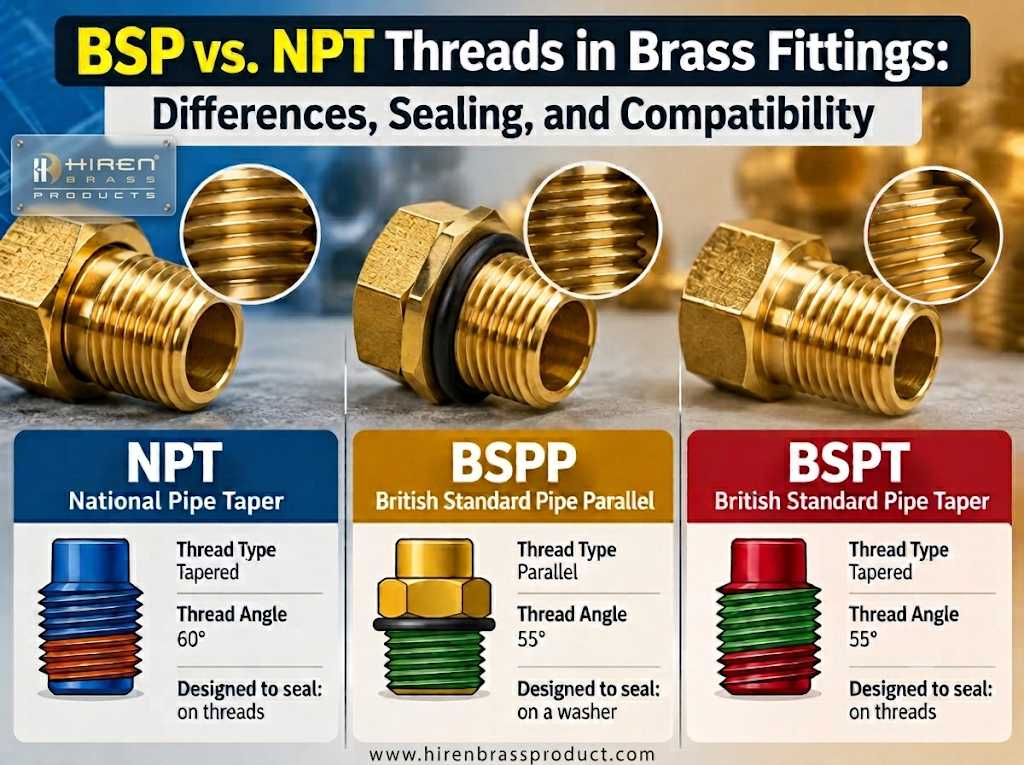
In threaded brass pipe fittings, the thread matters most, and BSP and NPT might look similar but aren’t directly interchangeable. You can’t select brass fittings based on nominal thread size alone. BSP includes parallel BSPP and tapered BSPT forms, and NPT is tapered. These thread systems differ in thread form, angle, pitch, dimensions, and sealing arrangements. The wrong thread can create sealing and connection issues.
In this blog, we will explain the key differences between BSP and NPT threads, examine compatibility and sealing methods, and show how to identify and select the correct thread for brass threaded fittings.
What Are BSPP, BSPT and NPT Threads?
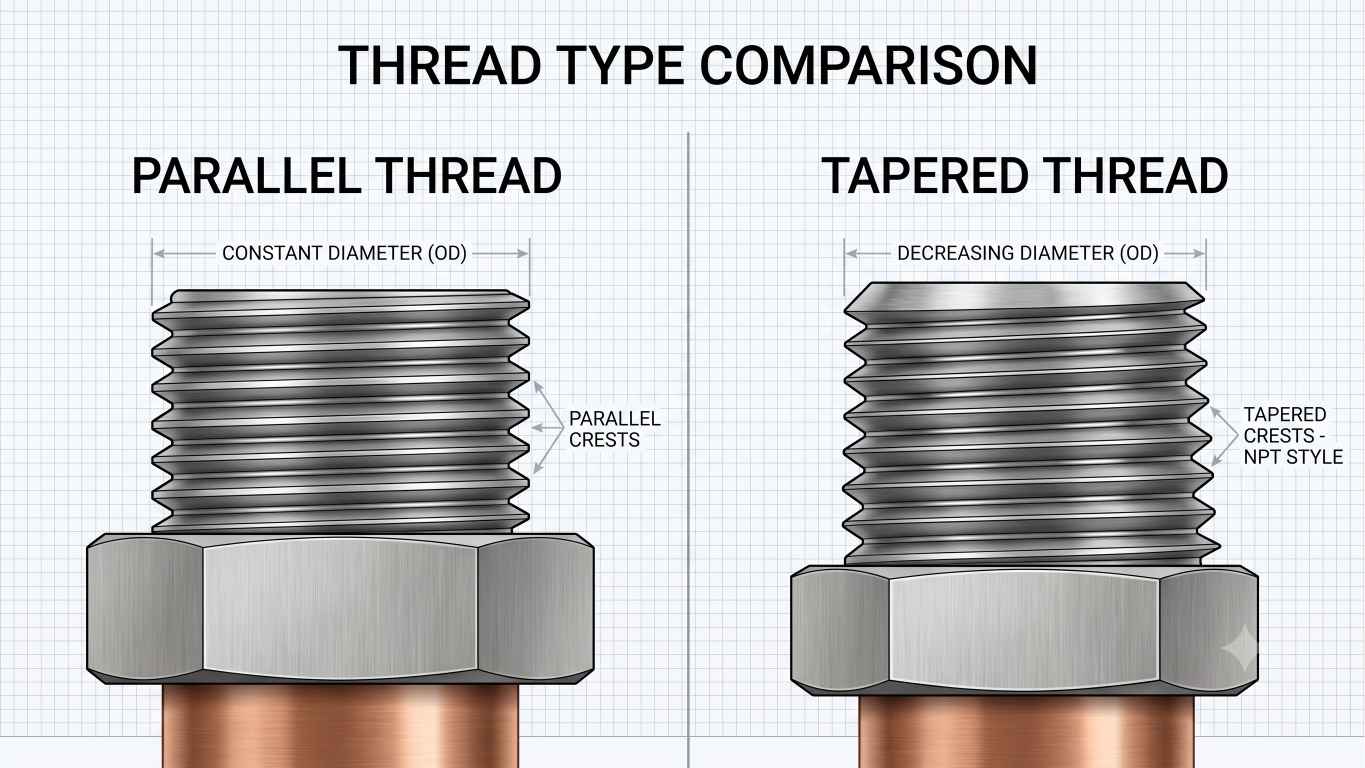
BSP (British Standard Pipe) is a family of pipe thread standard. Its include two main forms, BSPP and BSPT. BSPP (British Standard Pipe Parallel ) uses parallel threads, and ISO 228-1 covers this thread system. BSPT (British Standard Pipe Taper) uses tapered threads, and ISO 7-1 covers this pressure-tight pipe thread system.
NPT (National Pipe Taper) is a tapered pipe thread system, and ASME B1.20.1 covers NPT and related American pipe threads.
| Thread | Basic form | Standard |
|---|---|---|
| BSPP | Parallel | ISO 228-1 |
| BSPT | Tapered | ISO 7-1 |
| NPT | Tapered | ASME B1.20.1 |
In the next section, we will discuss BSP vs NPT: Key Thread Differences.
BSPP, BSPT, and NPT: Key Thread Differences
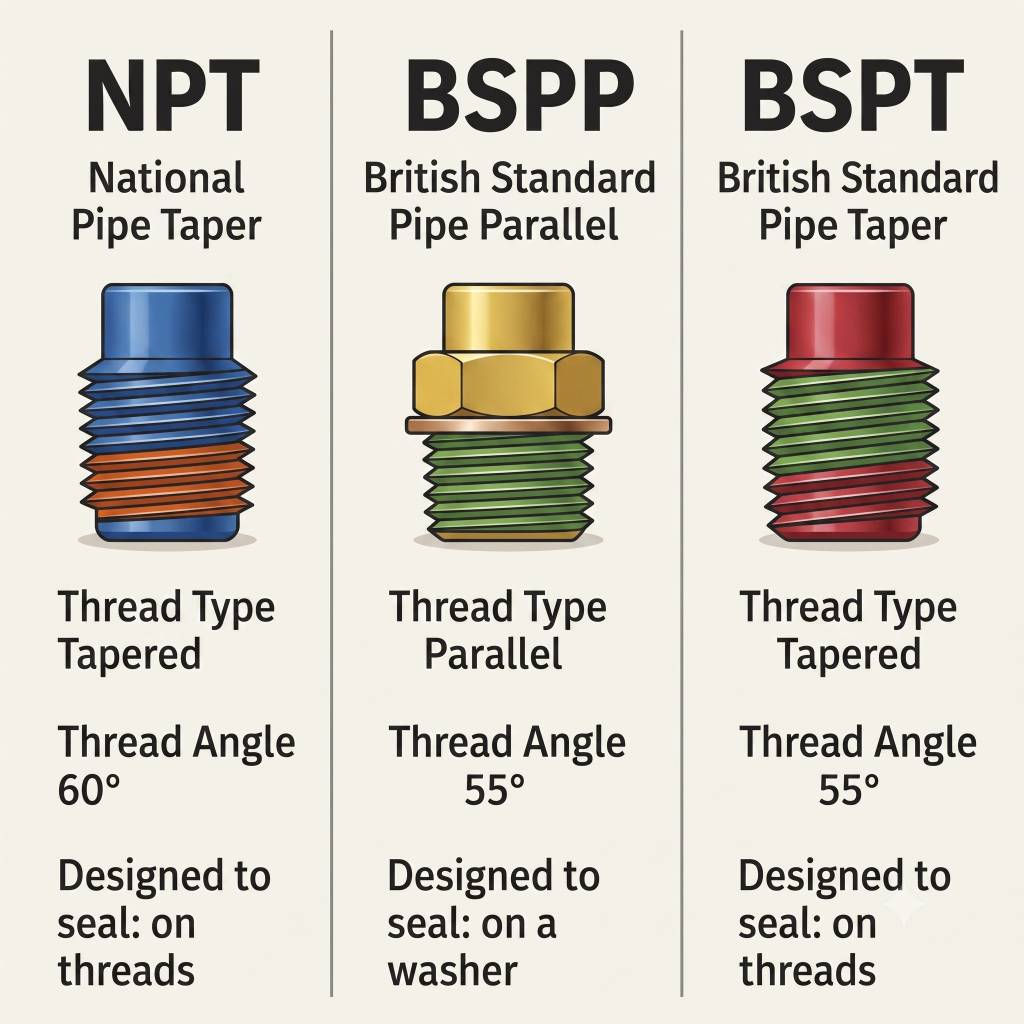
BSPT and NPT both use tapered pipe threads but have different thread designs. Also, BSPT and NPT both use the same nominal taper angle but have different thread profiles and thread angles. BSPT has a 55° thread angle and NPT has a 60° thread angle. BSPP also uses the same 55° thread angle, but it uses a parallel thread. For example, a 1/8-inch BSPT thread uses 28 TPI, and a 1/8-inch NPT thread uses 27 TPI.
| Feature | BSPP | BSPT | NPT |
|---|---|---|---|
| Thread form | Parallel | Tapered | Tapered |
| Thread angle | 55° | 55° | 60° |
| Standard | ISO 228-1 | ISO 7-1 | ASME B1.20.1 |
| Pitch | Measured in threads per inch | Measured in threads per inch | Measured in threads per inch |
| Thread profile | Rounded crest and root | Rounded crest and root | Flat crest and root |
| Taper angle | No taper | 1°47′ | 1°47′ |
| Typical designation | G for BSPP | R/Rc forms under ISO 7-1 | NPT |
| Measurement | Nominal pipe size plus thread dimensions/pitch | Nominal pipe size plus thread dimensions/pitch | Nominal pipe size plus threads per inch and other dimensions |
These differences matter most when you match a brass fitting to a mating component. A similar nominal size does not guarantee the same thread, so you need to confirm the thread standard and specification.
Can BSP and NPT Threads Be Connected Directly?
BSP and NPT brass fittings don’t use the same thread standard, and you should not assume they are directly interchangeable. So the question is, then how can we connect BSP fittings to an NPT port?
When an application uses both thread standards, you can use a brass adapter to solve this issue. For example, a brass adapter can have BSPP to NPT and BSPT to NPT thread combinations.
So, do not try to connect BSP and NPT directly based only on similar thread size. Use the correct conversion fitting for the two thread specifications.
How BSPP, BSPT, and NPT Connections Seal
BSPP, BSPT, and NPT do not use the same sealing method. The thread design and fitting design determine where the connection creates the seal.
How BSPP Connections Seal
BSPP uses parallel threads, so the threads can’t create the pressure-tight seal. The fittings use a sealing surface outside the thread with a suitable seal, like a gasket, bonded seal, or O-ring.
How BSPT Connections Seal
BSPT uses tapered threads, and the thread forms the pressure-tight joint. ISO 7-1 covers pipe threads where the pressure-tight joint occurs on the threads. The brass fittings manufacturers may specify a suitable thread sealing method for your application.
How NPT Connections Seal
NPT also uses tapered threads to create the threaded joint, but the thread can leave a spiral leak path, so use a suitable sealing method for pressurized fluid service. The exact sealing method depends on the fitting and service
Do not assume that every BSPP, BSPT, or NPT fitting uses the same seal. Before installation, check the specific brass plumbing fittings manufacturers specifications.
How to Identify and Match the Correct Thread
Before selecting brass fittings, first check the thread specification, and if the specification is unknown, identify the thread by its form, diameter, and pitch.
Check Product Markings and Documentation First
First consider the product drawing, marking, part number, and documentation. All details may already be available in documentation, then no need to measure.
Check Thread Form, Diameter, and Pitch
Check whether the thread runs parallel or tapers along its length. Then use a caliper to check the thread diameter and a gauge for thread pitch. Also note, do not identify the thread from diameter only because different thread standards can use similar nominal sizes.
Confirm the Thread Designation and Mating Connection
Compare the measured details with the correct thread standard. Then check whether you need an internal or external thread and the correct mating connection. Before choosing brass fittings, check the complete thread specification. ISO 228-1 defines BSPP thread dimensions, tolerances, and designation, while ISO 7-1 defines the relevant pressure-tight pipe-thread system. ASME B1.20.1 covers NPT dimensions and gauging.
Conclusion
BSP and NPT are both different standards and not directly interchangeable. When the application needs a different thread standard, use adapter fittings instead of forcing the connection. Always verify the exact thread specification and sealing method before installation. A correctly matched thread helps the fitting connect properly.
We are a custom brass fittings and brass parts manufacturer producing fittings and custom brass parts according to customer requirements. Send us your product drawings and details for manufacturing.