


Copper tube is highly formable, but bending does not simply change the direction of the tube. The copper tube outside material stretches when you bend, and the inside compresses. This deformation can change the tube shape, wall thickness, and final bend geometry. A poorly selected bend radius can lead to flattening, wrinkling, and wall thinning, while springback can change the final bend geometry.
The bending result depends on many things: tube material and temper, outside diameter, wall thickness, bend radius, and copper tube bending method and tooling. During bending, annealed and hard-drawn copper tubes can behave differently, so it's not necessary that the same bending approach will give the same result for each and every tube.
In the blog, we cover these factors, common bending methods, tooling, typical defects, application requirements, and inspection considerations.
Tube Material, Temper, and Dimensions
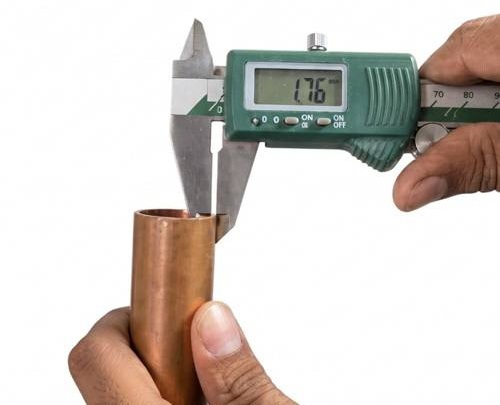
The first step is to identify the copper tube material grade. “Copper tube” alone does not give enough information for bending. ASTM B88 covers specific copper alloys for seamless copper water tube, while ASTM B75 covers seamless copper tube in specified copper grades and temper conditions. Before selecting a bending process, the applicable specification also defines important tube requirements, so you need to confirm the actual tube material.
Next, check the tube temper. Annealed and hard-drawn copper tubes have different mechanical properties, so they can respond differently during bending. Both annealed tubes and hard-drawn tubes can be bent with suitable equipment, and different minimum bend-radius values apply for some tube sizes and tempers. Do not assume that one bending setup will work the same way for every temper.
Also, do not just focus on nominal tube size, you need to confirm the actual outside diameter and wall thickness. These dimensions affect how the tube deforms during bending, and the relationship between outside diameter and wall thickness can affect bending behavior, especially in tighter bends. A higher OD-to-wall-thickness ratio can make the tube more sensitive to deformation and wrinkling under some bending conditions. Check the tube dimensions before selecting the bend radius and bending process.
Bend Radius and Geometry
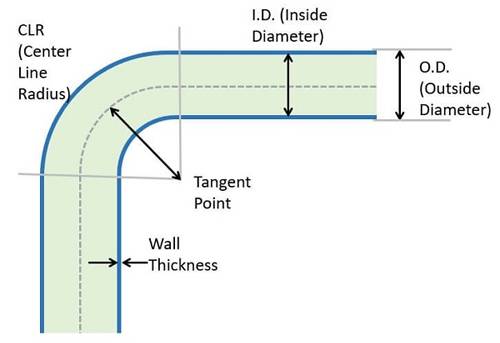
The bend radius defines how tightly the copper tube turns. Check the required centerline radius in the drawing and make sure it suits the tube size, temper, bending method, and tooling. For different tube sizes, there are different minimum bend-radius values and tempers, so do not use one fixed radius rule for every copper tube.
The bend angle also needs to be clear for each bend because it controls the amount of direction change and affects the final tube layout. Also check the straight distance between bends. The bender needs enough straight tube for proper positioning and clamping, and the bend spacing affects the finished part dimensions.
For tubes with multiple bends, define the bend sequence, spacing, angle, radius, bend direction, and bending plane. A correct angle alone does not define the complete three-dimensional shape.
Common Copper Tube Bending Methods
Rotary Draw Bending
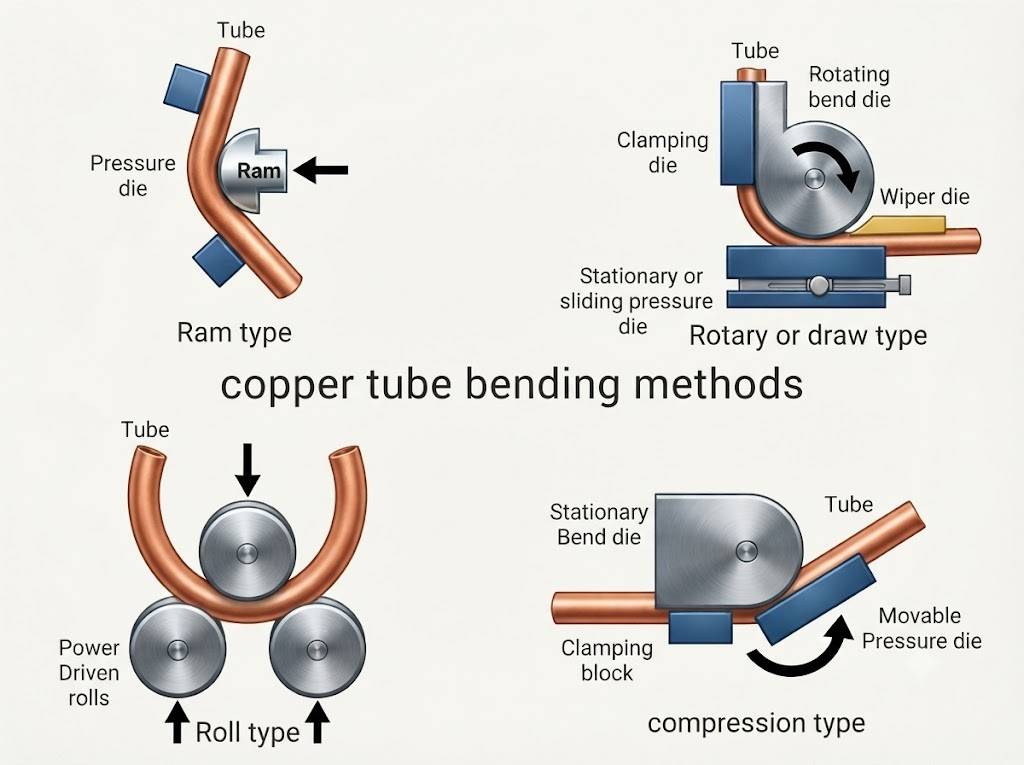
For the rotary draw bending method, you need a bend die to form the copper tube around a set radius. The machine clamps the tube and draws it around the bend die while the die controls the bend shape. This method gives good control over bend radius, bend angle, and bend orientation. Rotary draw bending is suitable for tighter bends and parts with multiple bends. Rotary draw machines can use a mandrel when the tube geometry and required quality need internal support, while some setups can work without a mandrel.
Ram/Press Bending
Ram (Press) Bending uses a ram to push the tube against supporting dies and form the bend. The process uses a three-point bending principle and has a simpler forming arrangement than rotary draw bending. It can work for copper tubes, but it generally gives less control over the tube cross-section during more demanding tight-radius bends. The actual result still depends on the tube, tooling, bending radius, and required tolerance.
Roll Bending
Roll bending forms the copper tube progressively as it moves through rollers. Three-roll systems can produce large radii and long, sweeping curves, making this method useful when the part needs a gradual bend rather than a tight fixed-radius bend. The exact process depends on the machine and tube, and some roll-bending systems form the tube without internal support.
The bending method should match the tube, required radius, bend geometry, and required dimensional control. The next section covers the tooling and internal support that help control the tube during bending.
Tooling and Internal Support
Bend Die and Clamp Die
The bend die, also called the bend former, sets the centerline radius and guides the tube around the required bend. The clamp die grips the straight section of the tube against the bend die, and the machine draws the tube around it. The exact die set depends on the tube outside diameter, centerline radius, bend angle, minimum straight length between bends, and machine setup.
Pressure Die
The pressure die holds the tube against the bend die during bending and supports the tube at the forming area. It helps control tube movement as the bend develops. The required pressure depends on the tube, tooling, machine, and bending conditions, so you should not use one fixed pressure value for every copper tube.
Mandrel
A mandrel sits inside the copper tube and provides internal support during bending. It helps limit tube collapse and cross-section deformation, especially when the bend becomes tighter or the tube wall becomes thinner. Plug mandrels can provide basic internal support, while ball mandrels can provide more support for more difficult bends. A rotary draw process does not always need a mandrel because some tube geometries can bend without one.
Wiper Die
A wiper die supports the tube near the inside of the bend and helps prevent wrinkles in the compressed tube wall. It becomes more useful for difficult bends, including tight-radius and thin-wall applications. The mandrel and wiper die do different jobs: the mandrel supports the tube from inside, while the wiper die supports the tube near the inside radius.
The tooling setup should match the tube dimensions, material condition, bend radius, and required bend quality. The next point covers the common defects that can occur during copper tube bending.
Common Bending Defects
Wrinkling
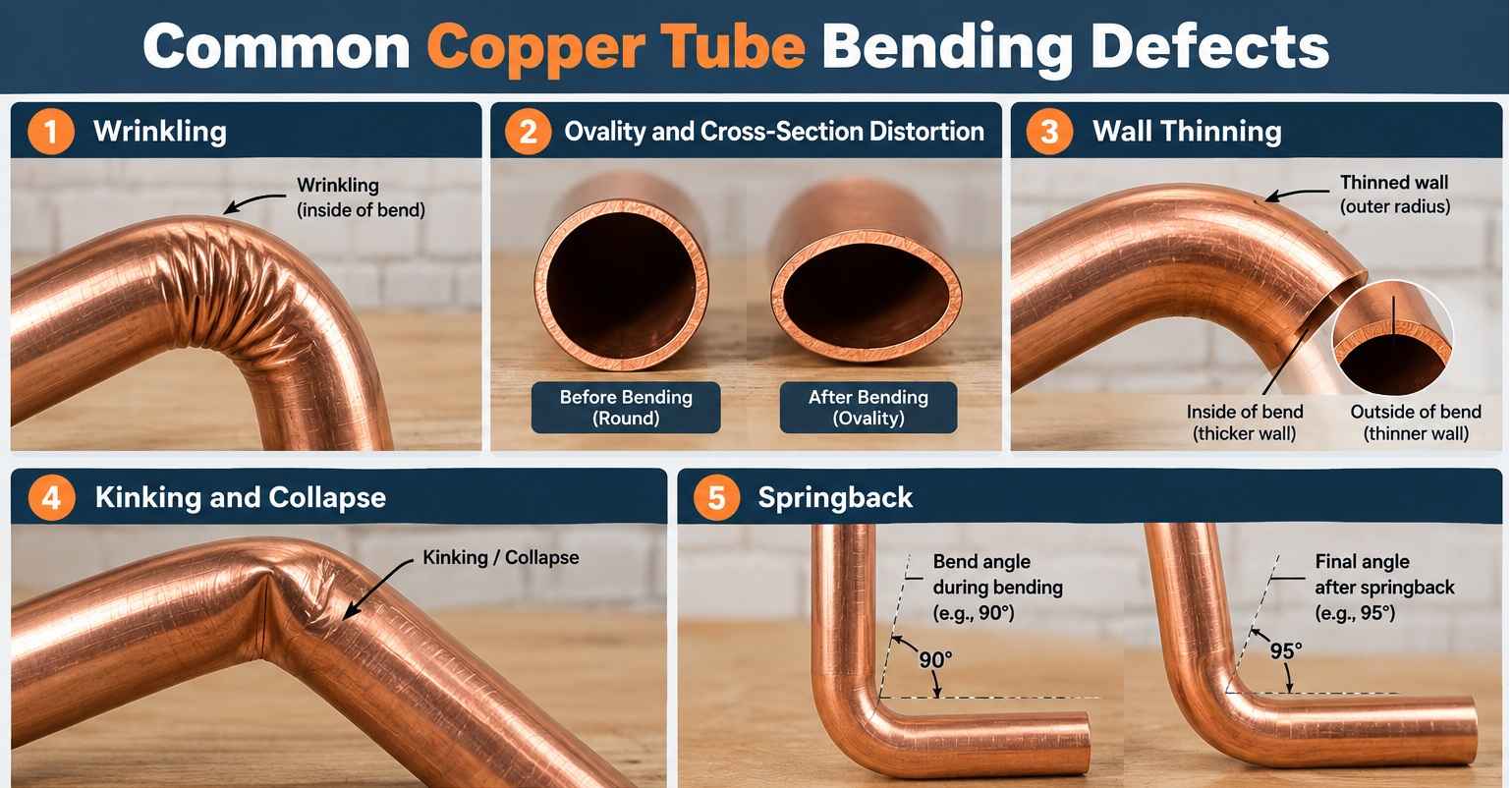
Wrinkling usually occurs on the inside of the bend, where the tube wall goes into compression. This compression can cause the wall to buckle and form visible wrinkles, especially with tight bend radii and thin-wall tubes. Proper tube support and suitable bending conditions can reduce the risk, but no single tool prevents wrinkling in every application.
Ovality and Cross-Section Distortion
The tube can lose its round cross-section during bending and become oval. This cross-section distortion comes from the deformation that occurs as the tube passes around the bend. Excessive ovality can reduce the available flow area and affect the structural behavior of the bent tube, depending on the application. A certain amount of deformation can occur during bending, so acceptance should follow the drawing and specification.
Wall Thinning
The material on the outside of the bend stretches during bending, so the wall can become thinner at the outside radius. The inside wall can become thicker as the material undergoes compression. Some wall-thickness change is a normal part of tube bending, but excessive thinning can become a problem when the remaining wall does not meet the required design.
Kinking and Collapse
Kinking creates a sharp local deformation in the tube, while collapse involves a more severe loss of the intended cross-sectional shape. These problems can develop when the tube, bend radius, tooling, support, and bending process do not suit the required bend. Tube slippage, non-annealed tubing, and an excessively short radius are among the conditions that can contribute to kinked and flattened bends in the tube-bending guidance.
Springback
Springback occurs when the copper tube elastically recovers after the bending force is removed. The final bend angle can differ from the machine setting, and the final bend radius can also change. Springback depends on material properties, tube geometry, and bending conditions. It does not automatically mean the bend has failed; it becomes a problem when the final geometry falls outside the required tolerance.
These defects can result from several factors acting together, including tube condition, bend radius, tooling, support, and process control. Check the finished tube against the required geometry and applicable acceptance requirements rather than assuming every visible deformation means the part has failed.
Application and Performance Requirements
Flow and Pressure Requirements
First, check the required flow rate and pressure for the copper tube application. The tube size and bend geometry form part of the fluid path, so the bends can contribute to pressure loss along with the straight tube and other components. The suitable copper tube for an application also depends on internal and external fluid pressure, installation conditions, service conditions, and the applicable requirements.
Installation Space
Check the available installation space before finalizing the tube layout. The bent tube needs enough clearance around nearby components, and the straight section near a fitting needs enough length for proper fitting engagement. This becomes more important in multi-bend tubing because the distance between bends also affects clamping and routing around obstacles.
Required Dimensional and Bend Accuracy
The finished tube needs to match the required bend angle, radius, bend position, spacing, overall dimensions, and connection alignment. A single bend can meet its angle requirement while the complete tube still misses the required assembly position. Accurate layout needs control of offsets, bend locations, changes in plane, and straight tube lengths.
Service Conditions
Check the conditions the copper tube will experience after installation. Operating temperature, pressure, temperature changes, vibration, thermal movement, and the surrounding environment can affect tube performance. Copper expands and contracts with temperature changes, and vibration combined with residual bending stress can contribute to fatigue at bends and connections. The applicable tube specification and design requirements should define the limits for the actual application.
These requirements should match the actual system and finished tube, not just the bending process. The next section covers how to inspect the bent copper tube against the required dimensions and condition.
Inspection of Bent Copper Tube
After bending, first check the tube for visible damage such as cracks, dents, gouges, buckling, and severe surface deformation. Visual inspection helps identify obvious problems, but it does not confirm internal wall condition or pressure integrity. The inspection should follow the applicable specification and acceptance requirements.
Next, check the final bend angle, bend radius where specified, bend position, spacing, overall dimensions, and connection alignment against the drawing. Check the bend angle after removing the tube from the bender and check the measurement length.
Check the tube cross-section through the bend when the application requires control of ovality. Bending can change the round tube section, so compare the measured cross-section with the specified acceptance limit. Do not assume that any ovality means rejection because the allowed amount depends on the drawing, product specification, and application.
Also check wall thickness at the bend when the application requires it. Bending can reduce the wall thickness at the outside of the bend, so the remaining wall may need verification for pressure, structural, or other design requirements.
Finally, compare the inspection results with the drawing, applicable product specification, code, and customer requirements. There is no single inspection method that applies to every bent copper tube.
Conclusion
Copper tube bending needs control from the tube selection stage through the final inspection. The tube material, temper, dimensions, bend geometry, bending method, tooling, and application requirements all affect the final result.
We provide custom copper tube bending according to your drawing. Share your drawing and tube requirements with our team to discuss your copper tube bending project.