

Brass fittings manufacturers and suppliers sell different designs and shapes in the market. There are many types available in the market, but which is the best and perfect fit for your application? You have to identify it. Wrong fittings can create issues, leaks, and may not work properly for your application. Brass pipe fittings selection is based on size, connection type, thread, pipe material, fluid compatibility, pressure, and temperature. All these things matter, not just shape. This blog explains how to identify fitting type, size, connection, compatibility, and operating requirements for the right brass pipe fittings.
Request a Quote for Custom Brass FittingsIdentify the Application and Fluid
Before choosing brass pipe fittings, you first have to identify what will flow through it and where your fitting will be used. Brass pipe fittings are used in various applications such as water, gas, HVAC systems, cooling lines, and other fluid systems, so not every brass fitting is suitable for every application.
The fluid must be compatible with the fitting and the sealing materials. Also, the surrounding environment, service conditions, and any application-specific requirements can affect fitting suitability. So, before choosing the fittings, you must check the brass fittings manufacturer's specifications for the intended fluid and application, including any required certifications. Once you know the application and fluid, you can move on to selecting the right type.
Choose the Right Brass Pipe Fitting Type
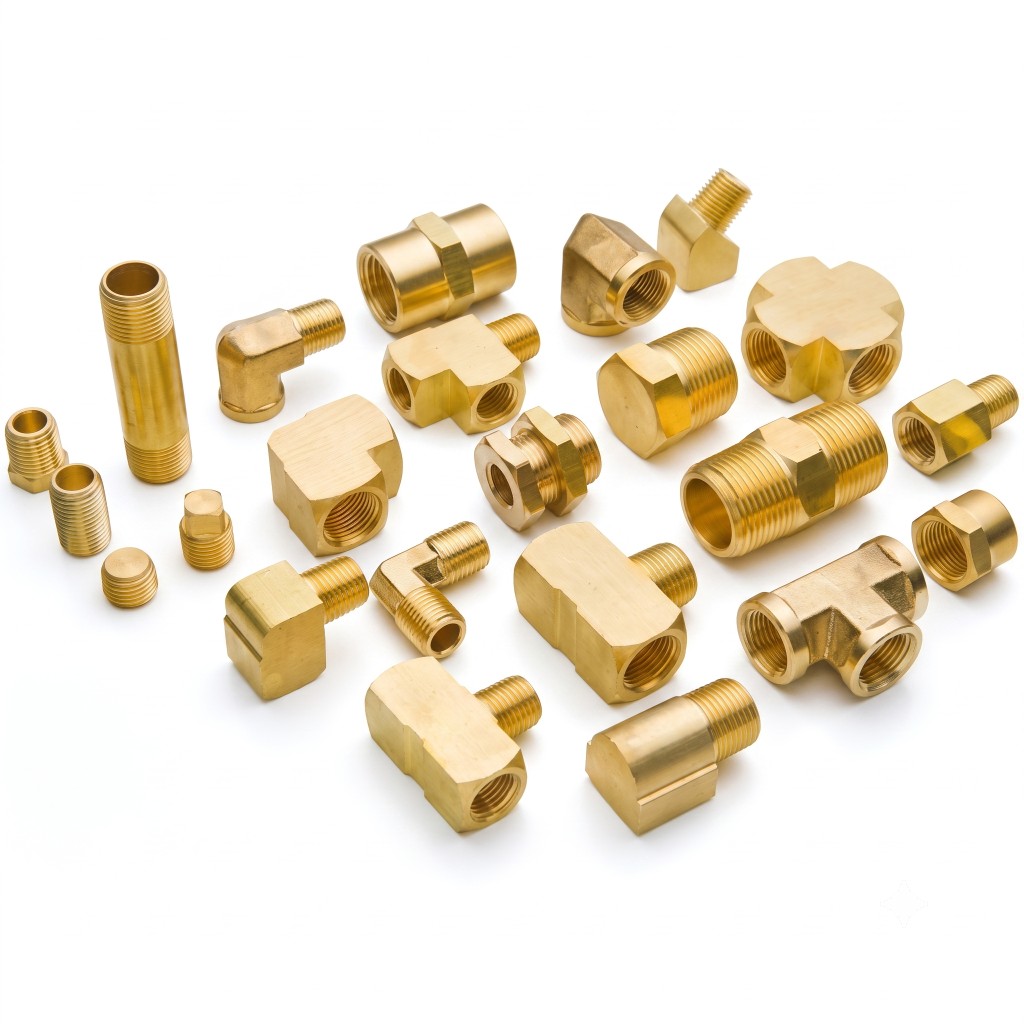
Each fitting type performs a particular job, such as changing direction, creating a branch, joining pipes, changing size, connecting different connection types, and closing a pipe. You have to identify the fittings you need for your requirements.
| Fitting type | What it does | When you may need it |
|---|---|---|
| Elbow | Brass elbow fittings changes the direction of the pipe run. | When the piping needs to turn, commonly 45° & 90°. |
| Tee | Brass Tee fittings connects three pipe ends and creates a branch. | When you need to branch a line three flow paths. |
| Cross | Connects four fitting ends. | When one line needs two branches or four connections. |
| Coupling | Brass coupling joins two pipe sections in a straight run. | When connecting two pipes of the compatible connection size. |
| Union | Joins two pipe sections while allowing the connection to be disconnected more easily. | Where future maintenance is important. |
| Adapter | Connects components with different connection types, configurations. | When connecting different connection methods. |
| Reducer | Changes the pipe connection from a larger size to a smaller size. | When the system needs to transition between different pipe sizes. |
| Reducing Bushing | Reduces a threaded connection from one size to another, commonly with male and female threads. | When a threaded connection needs a smaller outlet. |
| Nipple | Provides a short pipe section, commonly with threaded ends, to connect two fittings or components. | When two threaded fittings need a short connection between them. |
| Cap | Closes the end of a pipe by fitting over the pipe end. | When an unused pipe end needs to be closed. |
| Plug | Closes an opening by fitting into a threaded connection. | When a threaded port needs to be closed. |
After choosing the basic fitting type, you still need to check size, thread, connection type, pipe material compatibility, pressure, and temperature.
Check Size, Thread Standard, and Connection
For brass fittings installation, size and thread need to match the pipe and mating component. NPT, BSPT, and BSPP should not be treated as interchangeable just because the nominal size looks the same. If you want to connect different thread systems with each other, you may need a particular adapter. For accurate fittings, installation must match pipe size, thread standard, thread configuration, and connection type.
Match the Pipe Size
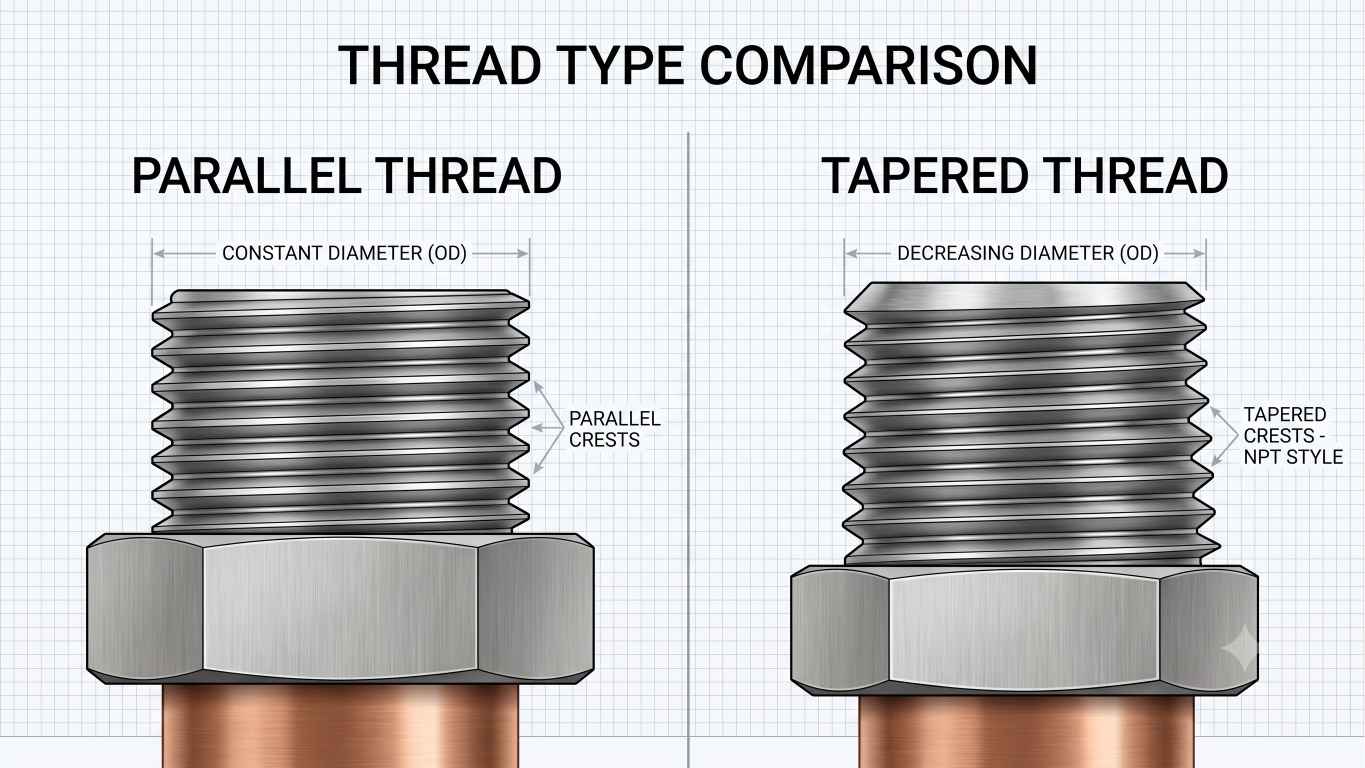
The fitting size needs to match the connection on the pipe, tube, valve, and other component being connected. A pipe's nominal size is a designation used for a piping system and does not necessarily equal a direct measurement of its outside diameter. The fitting must therefore be selected using the applicable pipe/fitting sizing system and manufacturer specification, rather than assuming the nominal number is the measured outside diameter.
Identify the Thread Standard
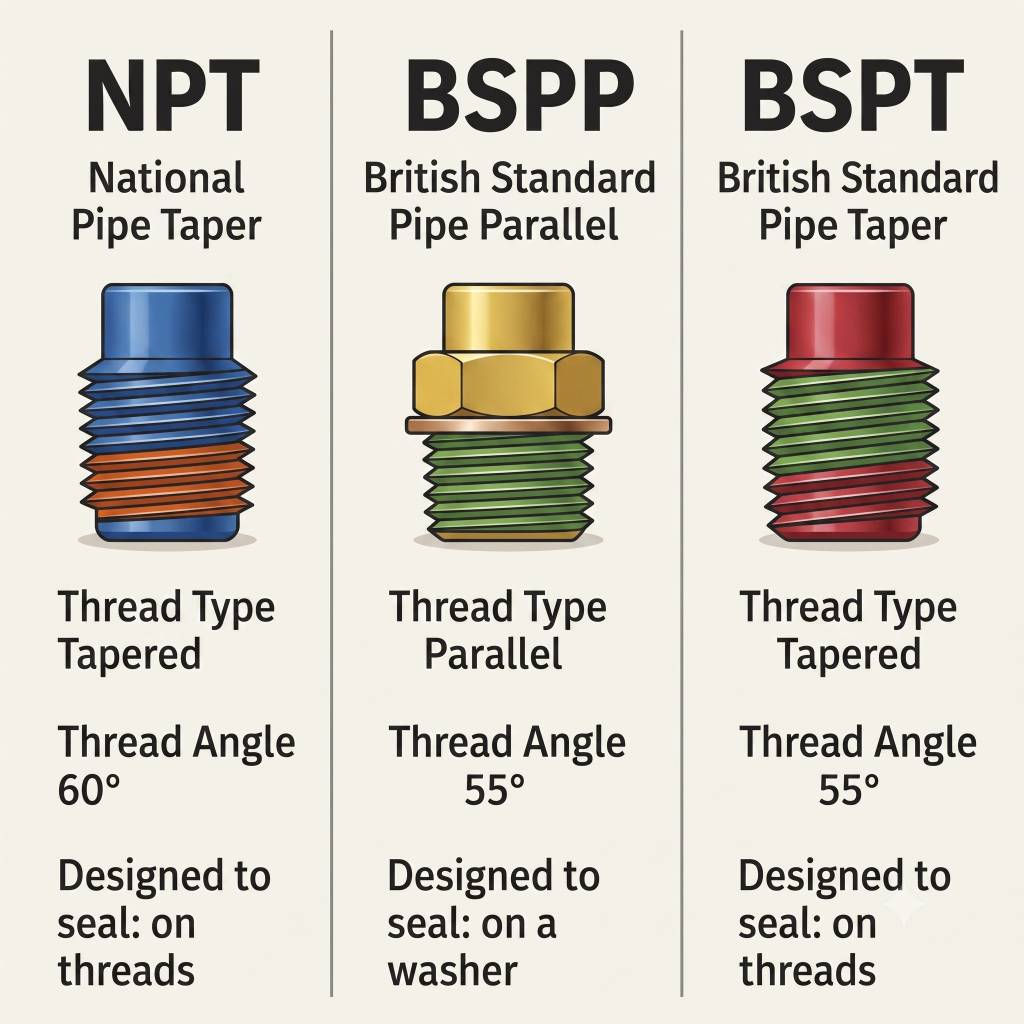
BSPT, NPT, and BSPP are not the same, and they have different thread types.
| Thread standard | Basic identification | Key point |
|---|---|---|
| NPT | National Pipe Thread, commonly used in the U.S. | Tapered pipe thread system ASME B1.20.1. |
| BSPT | British Standard Pipe Taper | Tapered thread system ISO 7-1. |
| BSPP | British Standard Pipe Parallel | Parallel thread system ISO 228-1; pressure sealing is made by a sealing surface/gasket rather than by the thread itself. |
Match Male/Female and Connection Type
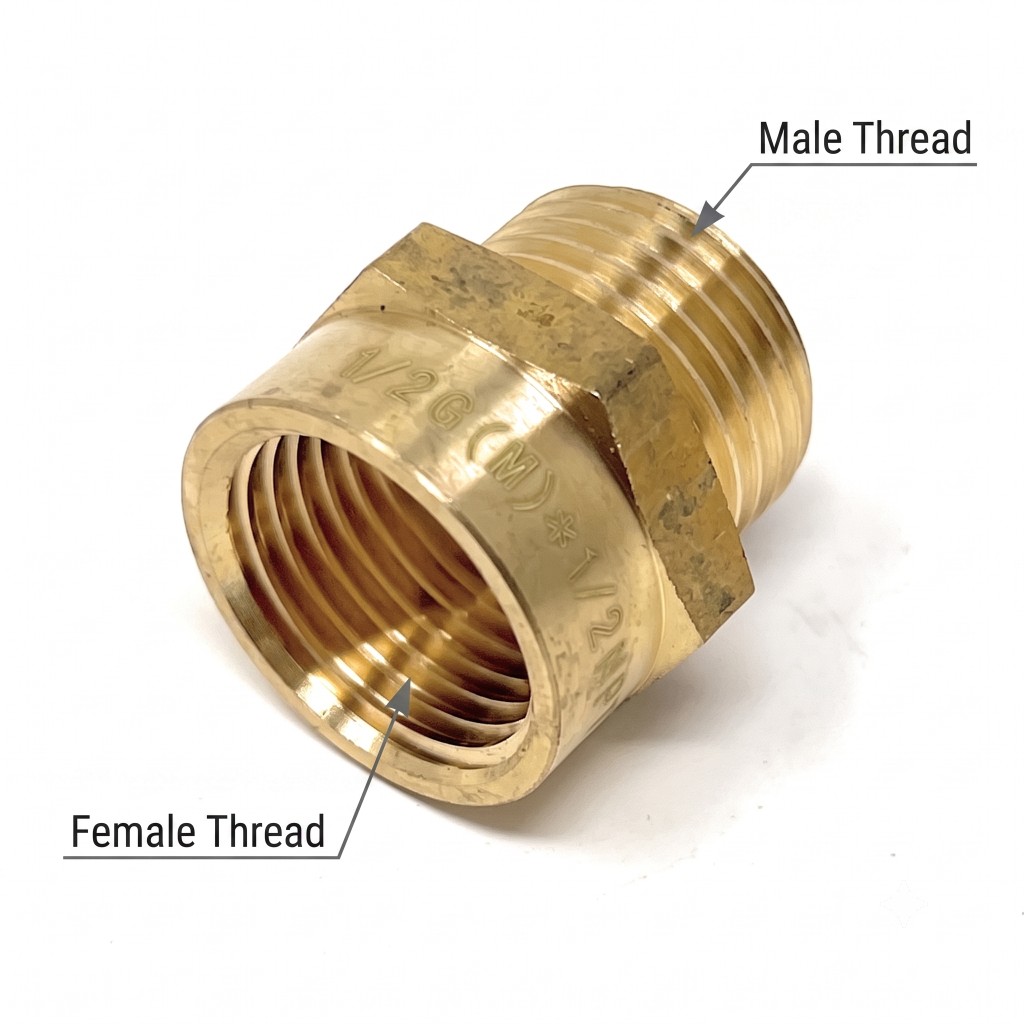
Male and female threads
Different thread types have different configurations, such as a male thread being an external thread and a female thread being an internal thread. The fitting and mating components need the correct complementary configuration. Also, some fittings have both male and female thread configurations.
Connection type
Not every fitting connects through pipe threads; it depends on the product and application. Connections can be threaded, compression, and push-to-connect. Thread standard tells you what thread system the threaded connection uses, and the connection type will tell you how the fitting connects to the pipe.
Check Pipe Material and Compatibility
Only knowing the pipe size is not enough when choosing brass pipe fittings. You also need to know what pipe material it is made from and whether the specific brass fittings are designed for that connection and material. Brass fittings do not work with every material.
Identify the Pipe or Tube Material
First, identify the material of the pipe or tube you are connecting to the brass fitting. It may be brass, copper, steel, PEX, CPVC, or other. The fitting must be designed for that specific pipe or tube and connection.
For example, some brass fittings are made to connect copper pipe to PEX tubing, and some other brass adapters are designed to connect PEX to an NPT-threaded component. So, do not assume that the pipe and fitting must always be made from the same material. Check the manufacturer's specifications for the specific fitting before choosing it.
Check Material and Fluid Compatibility
Pipe material is a single part of compatibility. You also need to check that sealing materials are compatible with the fluid and service conditions. Factors such as the fluid, concentration, temperature, and surrounding environment can affect material suitability.
Before choosing the fitting, check the manufacturer's product specifications and compatibility information for the fitting, pipe or tube, sealing materials, fluid, and application. Do not assume that a brass fitting is suitable for every pipe material, fluid, and operating condition.
Check Pressure and Temperature Ratings
Before choosing brass fittings for your use, check pressure and temperature conditions. Brass fittings do not have a single universal pressure and temperature rating. Rating vary by fitting type, size, and connection.
You have to check the manufacturer's specification before buying, including maximum working pressure and temperature and application restrictions. Make sure the fitting's rated pressure and temperature are suitable for your application's operating conditions.
Material, lead-free, certification
Not all brass fittings use the same material specification, and the required material/certification depends on the application.
Not all brass fittings use the same material specification, and the correct choice depends on the application. Potable-water applications may require specific lead-content and drinking-water requirements.
Brass Grade and Application Requirements
Do you have to care about the brass grade? Yes, you have to. Because brass fittings can be made from different brass alloys, you choose according to your application. C36000 is used for fittings and plumbing components, while C37700 is used for fittings and valve components, but that does not mean one is universally better. Also, DZR means dezincification-resistant brass. It is a material choice used where resistance to dezincification is required. Some manufacturers use DZR brass for drinking-water-related fittings and may specify materials such as EN 12165 CW 511L for particular products.
Lead-Free and Potable Water Requirements
Do not assume that simply because a fitting is brass, it is automatically suitable for potable water. Check the applicable lead-content requirements and drinking-water certification/listing for the exact product. Lead-free and potable-water certification are related but not identical concepts.
Some brass products are lead free and separately identify NSF certification for particular potable-water products. Their product specifications also state the exact application, pressure, temperature, and connection details. Similarly, some manufacturers identify products as meeting lead-free requirements and note applicable NSF/ANSI/CAN standards. So you have to check the actual certification/listing for the product, not simply focus on lead-free brass. NSF/ANSI/CAN 61 and lead-free requirements can be used as a U.S./North American example, while NSF/ANSI/CAN 372 relates to lead-content evaluation. Local requirements may differ.
Conclusion
Choosing the right brass pipe fitting means checking the application, fluid, fitting type, size, thread, connection, material compatibility, pressure, and temperature before buying. Always check the manufacturer's specifications to make sure the fitting matches your application and operating conditions.
We make custom brass pipe fittings according to your drawing and requirements. Contact us for an RFQ.