

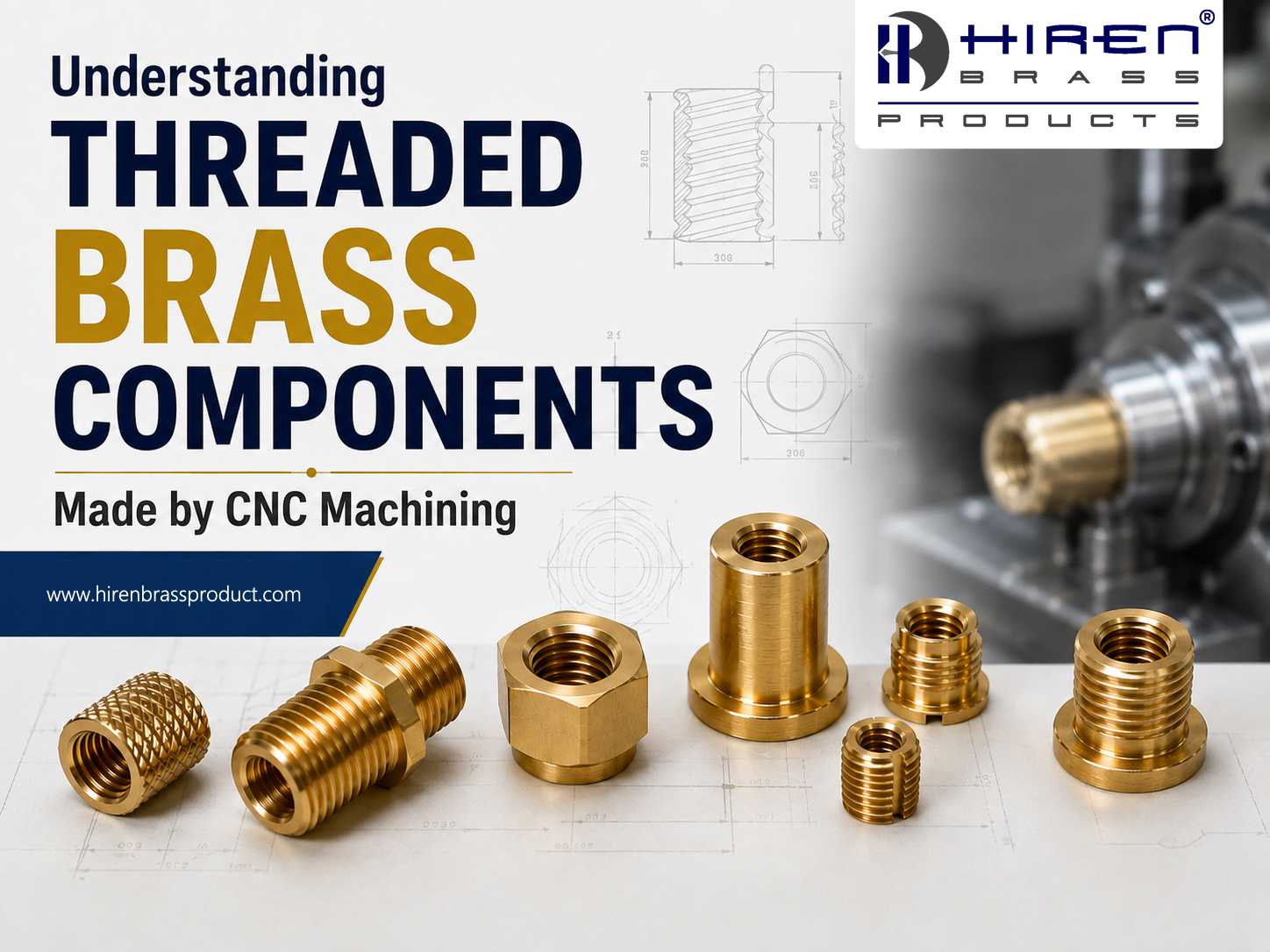
Brass threaded components are CNC machined parts with internal or external threads, or both, used to connect and fasten with other components. Brass material is suitable for CNC machining, and it's used for different components such as fittings, adapters, bushings, screws, valve parts, and other brass cnc turned parts.
In threaded brass components, the thread is not the only important thing. You need to consider thread standard, thread configuration, size, material grade, dimensions, and tolerances according to the application.
In this guide, we will cover how threaded brass components are made using CNC machining, thread types and standards, common applications, and the key factors to consider when choosing them.
Request a Quote for Custom Brass Threaded ComponentsHow Are Threaded Brass Components Made Using CNC Machining?
Brass CNC machining parts manufacturing is the process of turning a brass blank into a finished threaded component. The exact machining method depends on the part geometry and required features.
Step 1: Start with the brass material
Brass parts manufacturers starts with brass stock suitable for the components and mentioned in the customer drawing.
Step 2: CNC turning or milling
CNC turning
CNC turning uses a computer-controlled machine to rotate the workpiece while cutting tools move relative to it to remove material and create the required shape. CNC turning is mainly used for parts with cylindrical features and rotational symmetry.
Common CNC turned parts include shafts, pins, bushings, sleeves, spacers, threaded parts, adapters, and other cylindrical components. Depending on the machine configuration, tooling, and part geometry, CNC turning can produce internal and external threads, grooves, tapers, holes, and different turned profiles.
CNC Milling
CNC milling is used when components require features like flats, slots, and pockets.Common OEM cnc milling parts such as connector bodies, valve blocks, manifolds, brackets, and fitting bodies
Step 3: Machine the hole and outside diameter
Before the thread operation, the required feature needs to be prepared.
Internal thread
For an internal thread, the part needs a suitable hole before the machine produces the thread. Internal threads can be produced using methods such as cutting taps, single-point cutting tools, or forming taps.
External thread
For an external thread, the machinist first machines the outside diameter to the required size and then produces the thread on that outside surface. Threading tools can be used to create external threads on turned parts.
Step 4: Produce the thread
The threading method depends on the thread, component geometry, machining process, production requirements, and available tooling.
Internal threads can be produced using:
Tapping
A tap cuts the internal thread in a prepared hole. CNC machines can use rigid tapping and other tapping methods.
Thread milling
A thread mill creates the thread by following a controlled helical tool path. Machinists use thread milling for both internal and external threads, and the tool path controls the thread geometry.
External threads
Machinists can produce external threads with CNC turning/threading tools or thread milling, depending on the part geometry and machining process.
Step 5: Finishing and checking
After machining, the component may need operations such as:
- deburring
- cleaning
- surface finishing, where specified
- dimensional/thread inspection
Thread Types and Standards Used in Brass Components
In threaded brass components use different thread configurations and standards. Internal and external threads describe the location of the thread on the component, while Metric, UNC/UNF, NPT, BSPP, and BSPT describe different thread systems and standards. The correct thread standard must match the mating component.
| Thread standard | Basic type | Main point |
|---|---|---|
| Metric (M) | Metric screw thread | Uses metric thread sizes with defined diameter, pitch, and tolerance requirements under the ISO metric thread system. |
| UNC / UNF | Unified inch screw threads | UNC and UNF belong to the Unified inch screw-thread system covered by ASME B1.1, which defines thread form, series, class, tolerance, and designation. |
| NPT | Tapered pipe thread | ASME B1.20.1 covers NPT and related inch pipe threads, including their dimensions and gauging requirements. |
| BSPP | Parallel pipe thread | ISO 228-1 defines BSPP-type parallel pipe threads. The thread itself does not make the pressure-tight joint; the design uses the mating sealing surfaces and an appropriate seal. |
| BSPT | Tapered pipe thread | ISO 7-1 defines the dimensions, tolerances, and designation for pipe threads that make pressure-tight joints on the threads. |
Internal and external describe the thread configuration, not the thread standard. For example, a brass component can have an internal or external thread that follows a particular Metric, UNC/UNF, NPT, BSPP, or BSPT specification. The specification can also include size, pitch, and tolerance requirements, so the thread name alone does not fully define the mating thread.
BSPP and BSPT are also not the same. BSPP uses parallel threads under ISO 228-1, while ISO 7-1 covers the pressure-tight pipe-thread system associated with BSPT. Do not treat them as interchangeable just because they have the same nominal size.
Common Applications of Threaded Brass Components
Threaded brass components are used where threaded connections are needed. Brass CNC turning parts manufacturers commonly use them in fluid, electrical, automotive, plumbing, and general hardware applications.
| Application | Common threaded brass components |
|---|---|
| Plumbing and fluid systems | Brass pipe fittings, adapters, bushings, valves, and connectors |
| Automotive | Fuel fittings, sensor housings, valve components, and electrical connectors |
| Electrical and electronic | Terminals, electrical connectors, and small precision hardware |
| Pneumatic and hydraulic systems | Threaded fittings, adapters, and fluid connectors |
| Valves and instrumentation | Valve parts, stems, connectors, and machined components |
| Industrial machinery | Fittings, connectors, hardware, and machine components |
| General hardware | Screws, rivets, hinges, knobs, and other machined parts |
Key Factors to Consider When Choosing Threaded Brass Components
For choosing the right CNC threaded part, only the thread is not enough. You need to check the thread specification, brass grade, dimensions, tolerances, and application.
Check Thread Standard, Size, and Configuration
First, check the thread standard, size, pitch, and whether your component needs an internal or external thread. Also, make sure the thread specification matches the mating component. Similar nominal sizes do not mean the threads are the same. Different thread standards can have different dimensions.
Check Brass Grade and Application
Choose the brass grade according to the component requirements and application. Different brass grades have different chemical compositions. If the component contacts a fluid, check whether the selected brass grade suits those conditions.
Check Dimensions and Tolerances
Check the overall dimensions, thread dimensions, thread depth, hole dimensions, and critical feature tolerances. The thread also needs enough feature size and machining space in the CNC process. Do not assume one CNC tolerance applies to every component.
Check Drawing and CNC Machining Requirements
For custom threaded brass components, make sure the drawing includes the material grade, thread standard, thread size, configuration, dimensions, tolerances, thread depth, and other critical features. Clear drawing information helps the manufacturer machine the required component correctly.
FAQs
1. Can a brass component have different thread standards on each end?
Yes. A single brass component can use different thread standards on each end. for example, makes brass conversion fittings with NPT on one end and BSPP on the other. The two thread specifications still need to match their respective mating components.
2. Can a CNC-machined brass component use a thread that is not listed as a standard thread?
Yes, CNC machining can produce custom thread forms, but the manufacturer needs complete thread information such as the profile, pitch, major and minor diameters, tolerance, thread depth, and other required dimensions.
3. Does the thread standard also determine the sealing method?
It can. Different thread systems use different sealing arrangements. ISO 7-1 covers pipe threads that make pressure-tight joints on the threads, while ISO 228-1 covers parallel pipe threads that do not make the pressure-tight joint on the threads.
4. What happens if a CNC threaded hole is deeper than the threading tool can reach?
The manufacturer may need specialized tooling or a different machining method when the required thread depth exceeds the available tool reach. Deep threaded holes can increase machining difficulty and cost, and blind holes also need enough unthreaded depth for tap lead and chip evacuation.
5. How much thread engagement does a brass component need?
There is no single thread-engagement length that works for every brass component. The required engagement depends on the thread size, material strength, load, thread geometry, and joint design.
Conclusion
The right threaded brass component should match the actual application and mating connection. Clear thread, material, and drawing requirements help avoid problems during manufacturing and assembly.
We make custom brass CNC threaded components according to customer drawings and requirements. Contact us for an RFQ.