

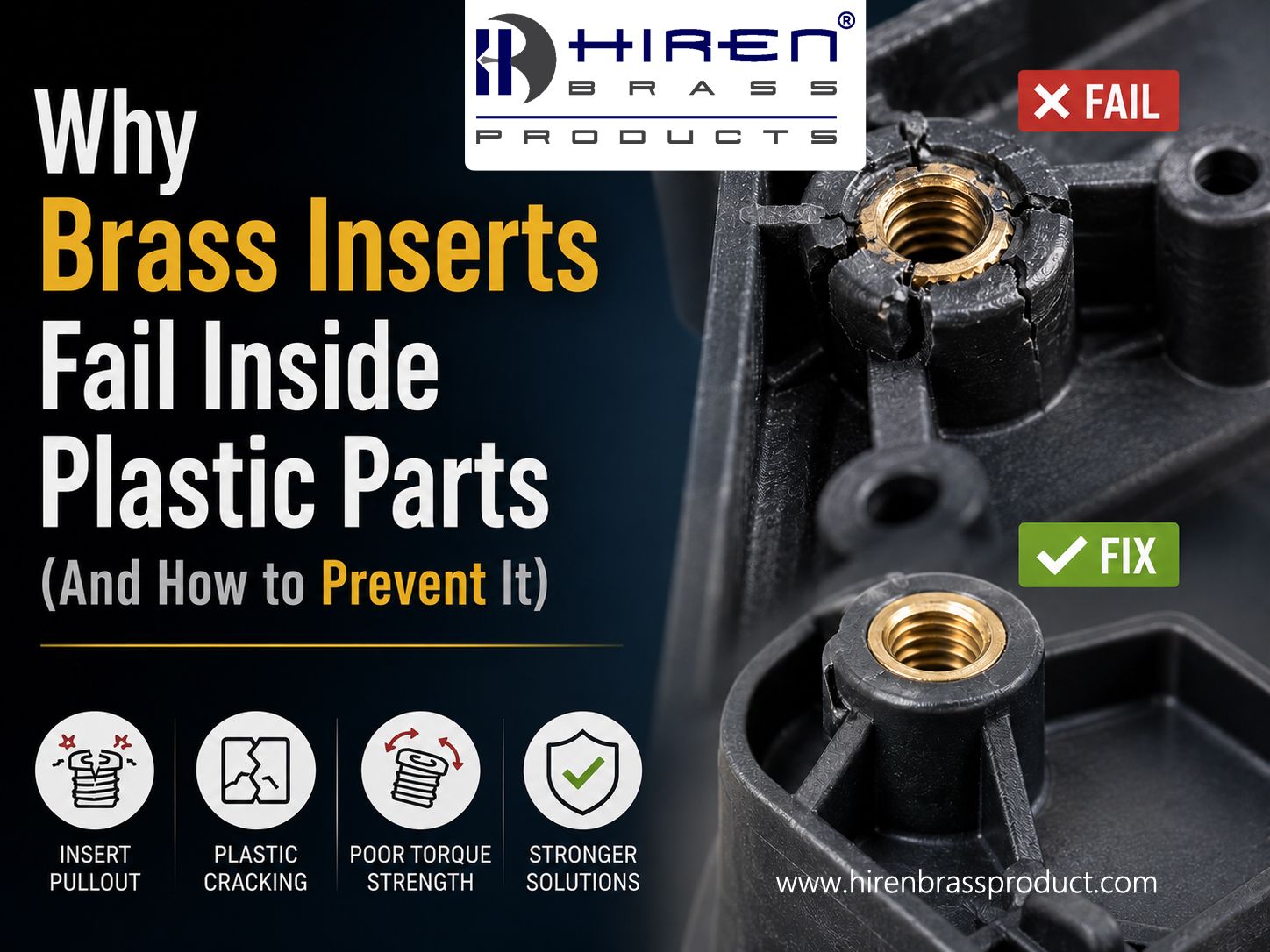
Brass threaded inserts are widely used in plastic parts to create durable and reusable threads that can withstand repeated assembly. But an insert can fail in a plastic part due to design, insert selection, plastic material, and installation errors. Common failure modes include insert pull-out under load and insert rotation during tightening.
This guide explains the most common brass insert failure modes and installation practices that help prevent them.
Why Brass Insert Failures Matter
Brass insert failures matter because they can increase maintenance, repair, and service costs. If a brass insert fails, it may require replacing the plastic part, reworking the assembly, and additional inspection and testing, depending on the application.
Failures such as insert pull-out reduce the reliability of bolted joints and may lead to loss of preload, resulting in joint loosening over the product's service life.
Brass inserts are specifically used to improve pull-out resistance, torque resistance, load-carrying capability, and long-term joint integrity compared with threads formed directly in plastic. Insert failure directly reduces joint strength and can result in loss of joint integrity. Choosing a reliable brass inserts manufacturer is also important because insert dimensions, knurl design, material quality, and manufacturing consistency directly affect installation performance and long-term joint reliability.
How Brass Inserts Stay Locked Inside Plastic
Before moving to why brass inserts fail in plastic parts, we first need to understand how brass inserts stay locked inside a plastic part. For heat-set and ultrasonic inserts, the surrounding thermoplastic melts during installation, while for press-in inserts, the plastic deforms under the installation force. For molded-in inserts, molten plastic flows around the insert during injection molding.
The primary retention mechanism is that the plastic flows into the insert's knurls, grooves, and barbs, creating a mechanical interlock that provides pull-out and rotation resistance. After the insert reaches its final position, the plastic cools and solidifies (for heat-set, ultrasonic, and molded-in inserts), while press-in inserts rely on plastic deformation for permanent retention.
The final mechanical interlock is formed between the plastic and the insert's external retention features, and retention depends on complete filling of these features.
Common Failure Modes of Brass Inserts
Brass inserts can fail in different ways depending on the interaction between the insert, plastic material, and applied loads.
Pull-Out Failure
The insert is pulled axially out of the plastic because the surrounding plastic no longer provides sufficient retention. A few signs to identify this failure are: the insert comes out of the plastic part, the insert may remain attached to the screw, the plastic around the insert may be damaged, and the joint can no longer maintain clamping force.
Insert Rotation (Torque-Out)
The brass insert rotates inside the plastic instead of remaining fixed. Common symptoms include: the insert spins while tightening and loosening the screw, the screw cannot be properly tightened, the joint becomes loose, and the required tightening torque cannot be achieved.
Boss Cracking
Cracks develop in the plastic boss around the insert. The cracks may appear during installation. You can identify this failure by visible cracks around the insert, cracks extending along the boss, broken plastic, and reduced structural support for the insert.
Jack-Out / Pull-Through
Jack-out occurs when the brass insert moves upward toward the surface of the plastic part instead of remaining fully seated. This can occur under service loads or if the insert position is incorrect. Common symptoms include the insert protruding above the surface, the insert no longer being flush, loss of clamping performance, and reduced retention in the plastic.
Pull-through occurs when the insert is forced completely through the plastic under axial loading, resulting in loss of retention and joint integrity.
What Causes Brass Inserts to Fail?
Incorrect Hole Diameter
One of the biggest causes of brass insert failure in plastic parts. If the hole is too large or too small, it prevents proper engagement with the insert's retention features. An oversized hole reduces pull-out resistance and torque resistance, while an undersized hole can cause stress concentration, boss cracking, and installation difficulty.
Insufficient Plastic Flow Around the Insert
If the plastic does not completely fill the insert's knurls and grooves, it results in poor retention, reduced pull-out resistance, and reduced torque resistance. This is one of the primary reasons for reduced insert performance.
Incorrect Boss Design
The plastic boss provides structural support for the brass insert. If the boss has thin walls, a small diameter, insufficient support, and contains knit lines, the insert may have reduced retention, leading to pull-out, rotation.
Wrong Installation Method and Temperature
Choosing the wrong installation method, poor fixturing, too much heat, too little heat, and an incorrect insertion speed (too fast or too slow) can cause brass insert failure.
Incorrect Insert Selection
Choosing the wrong insert length, knurl pattern, insert type, installation method, and application load requirements can result in poor torque resistance and pull-out resistance.
Plastic Material Limitations
Plastic material is very important. High glass-filled or mineral-filled plastics may require different hole sizes because the material properties affect installation and insert retention.
How to Prevent Brass Insert Failures
You can prevent brass insert failures by considering the following:
- Use the correct hole size recommended for the insert and plastic material.
- Design proper boss dimensions to provide adequate support for the insert.
- Select the right insert for the plastic material, installation method, and application load requirements.
- Use the correct installation method and recommended installation parameters.
- Verify complete plastic filling of the insert's knurls, grooves, and other external retention features.
Conclusion
Brass insert failures are often preventable when the insert, plastic part, and installation process are designed to work together. Selecting the right insert and following proper installation practices helps improve joint reliability and long-term performance.
If you need custom brass inserts manufactured to customer drawings, contact us. We manufacture custom brass inserts in a wide range of thread sizes, knurl patterns, dimensions, and finishes to meet your application requirements.